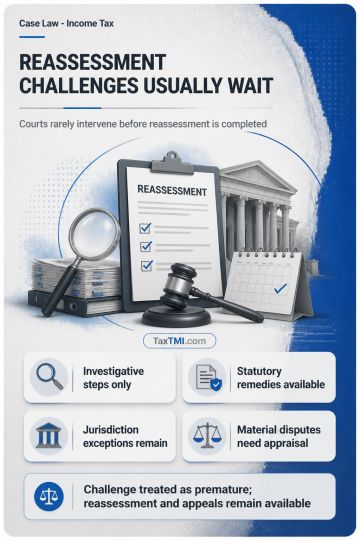
Preliminary reassessment proceedings generally require statutory remedies unless jurisdiction is wholly absent or mandatory conditions are patently br...
Agricultural land classification requires cumulative factual indicators, while industrial-purpose land and absent agricultural use defeat reinvestment...
Composite residential flat exemption upheld where supplementary agreement merged adjoining units and additional evidence supported the taxpayer's inve...
Insolvency and BankruptcyFebruary 11, 2022Case LawsAT
Initiation of CIRP - The I&B Code, 2016 is not a ‘Debt Enforcement Procedure’. The application of an ‘operational creditor’ is not maintainable, if the ‘Corporate Debtor’ has a dispute about its outstanding/debt. The ‘dispute’ is to be seen by the ‘Adjudicating Authority’ as one based on tenable substantial grounds. In this connection, it is relevantly pointed out that if there is a ‘dispute’ about the debt, then, it is for the ‘applicant’ to approach the competent Civil Court to decide the triable issues. In short, the ‘Adjudicating Authority/Appellate Tribunal’ is not to be utilised as a ‘Debt Collecting Agent’. - AT
Initiation of CIRP - The I&B Code, 2016 is not a ‘Debt Enforcement Procedure’. The application of an ‘operational creditor’ is not maintainable, if the ‘Corporate Debtor’ has a dispute about its outstanding/debt. The ‘dispute’ is to be seen by the ‘Adjudicating Authority’ as one based on tenable substantial grounds. In this connection, it is relevantly pointed out that if there is a ‘dispute’ about the debt, then, it is for the ‘applicant’ to approach the competent Civil Court to decide the triable issues. In short, the ‘Adjudicating Authority/Appellate Tribunal’ is not to be utilised as a ‘Debt Collecting Agent’. - AT
Note: It is a system-generated summary and is for quick reference only.
 TaxTMI
  TaxTMI
 of 4814














 Join Channel