Food supplement classification requires common parlance and authoritative tests, preventing treatment as proprietary Ayurvedic medicines without suppo...
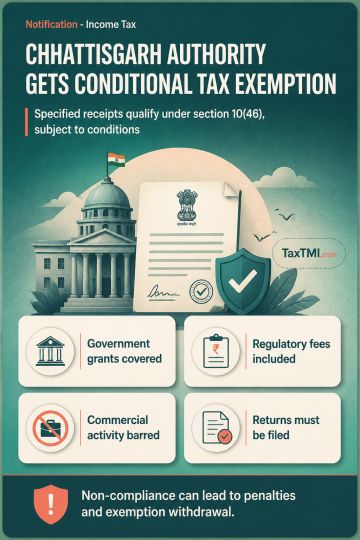
Specified regulatory authority income receives conditional tax exemption, subject to non-commercial activity, unchanged income character, and return f...
Tax exemption for regulatory authority income applies retrospectively, subject to non-commercial activity, unchanged income sources, and return-filing...
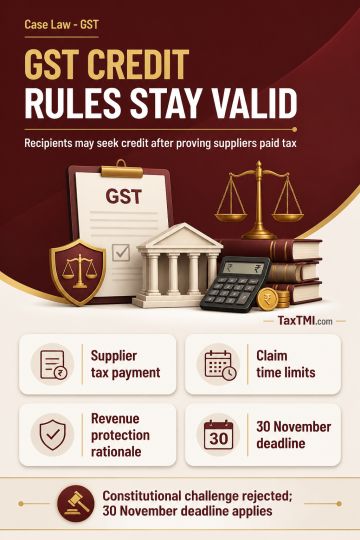
Input tax credit conditions remain constitutionally valid, with eligible recipient claims considered under GST circulars and retrospective filing dead...
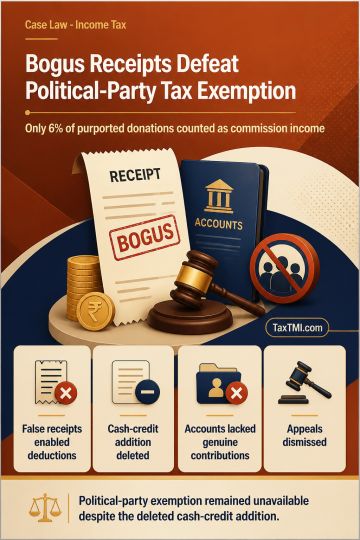
Bogus donation receipts justified commission income assessment and defeated political-party tax exemption for inaccurate accounts and reporting failur...
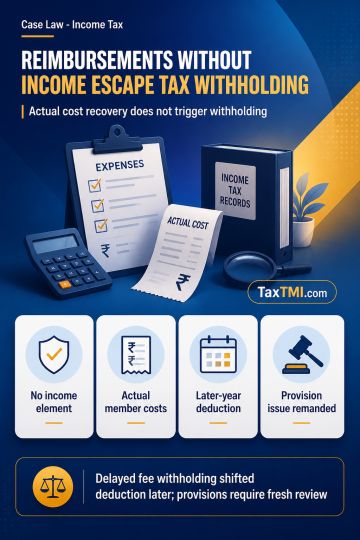
Pure reimbursement without income element escapes tax withholding, while delayed withholding and unsupported provisions face deferred or renewed scrut...
Page of 4819
Press 'Enter' after typing page number.
1061 to 1080 of 96365 Results
❮
❯
❯❯
0 / 200
Expand Note
Add to Folder
No Folders have been created
+
Are you sure you want to delete "My most important" ?
Insolvency and BankruptcyFebruary 11, 2022Case LawsAT
Initiation of CIRP - The I&B Code, 2016 is not a ‘Debt Enforcement Procedure’. The application of an ‘operational creditor’ is not maintainable, if the ‘Corporate Debtor’ has a dispute about its outstanding/debt. The ‘dispute’ is to be seen by the ‘Adjudicating Authority’ as one based on tenable substantial grounds. In this connection, it is relevantly pointed out that if there is a ‘dispute’ about the debt, then, it is for the ‘applicant’ to approach the competent Civil Court to decide the triable issues. In short, the ‘Adjudicating Authority/Appellate Tribunal’ is not to be utilised as a ‘Debt Collecting Agent’. - AT
Initiation of CIRP - The I&B Code, 2016 is not a ‘Debt Enforcement Procedure’. The application of an ‘operational creditor’ is not maintainable, if the ‘Corporate Debtor’ has a dispute about its outstanding/debt. The ‘dispute’ is to be seen by the ‘Adjudicating Authority’ as one based on tenable substantial grounds. In this connection, it is relevantly pointed out that if there is a ‘dispute’ about the debt, then, it is for the ‘applicant’ to approach the competent Civil Court to decide the triable issues. In short, the ‘Adjudicating Authority/Appellate Tribunal’ is not to be utilised as a ‘Debt Collecting Agent’. - AT
Note: It is a system-generated summary and is for quick reference only.
 TaxTMI
  TaxTMI
 of 4819









 Join Channel