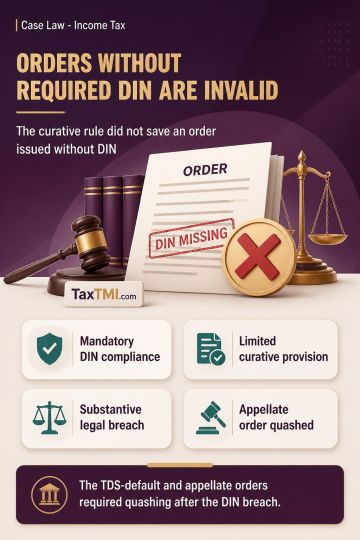
Document Identification Number compliance renders TDS-default orders invalid where mandatory DIN requirements are breached and curative provision does...
Revision u/s 263 by CIT - Non reference of matter to the TPO - no prudent business person properly instructed in law would have inferred the TP risk parameter as a reason for scrutiny so as to mandatorily make reference u/s. 92C of the Act in terms of CBDT Instruction No. 3/16 and failure to make such reference made the assessment order erroneous. In our opinion, the TP risk parameter was not one of the reasons for limited scrutiny of the case and as such the PCIT was not justified in invoking jurisdiction u/s. 263 - AT
Revision u/s 263 by CIT - Non reference of matter to the TPO - no prudent business person properly instructed in law would have inferred the TP risk parameter as a reason for scrutiny so as to mandatorily make reference u/s. 92C of the Act in terms of CBDT Instruction No. 3/16 and failure to make such reference made the assessment order erroneous. In our opinion, the TP risk parameter was not one of the reasons for limited scrutiny of the case and as such the PCIT was not justified in invoking jurisdiction u/s. 263 - AT
Note: It is a system-generated summary and is for quick reference only.
 TaxTMI
  TaxTMI
 of 4918