Cross-examination rights and corroborated evidence limit customs penalties for misdeclaration in genuine import transactions involving documented clea...
Tariff classification of vehicle gear components follows the specific gearing entry, displacing motor-vehicle parts classification and related liabili...
Necessary-party requirements limit impleadment of independent entities, while deferred consideration does not create an appealable adverse determinati...
Food supplement classification requires common parlance and authoritative tests, preventing treatment as proprietary Ayurvedic medicines without suppo...
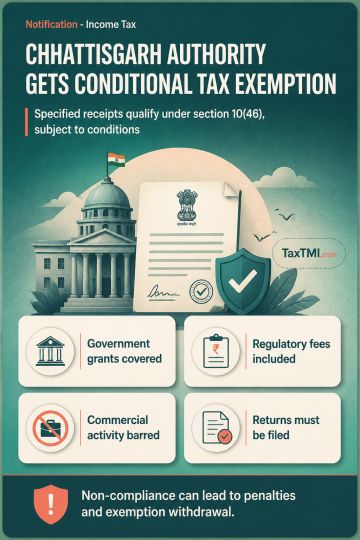
Specified regulatory authority income receives conditional tax exemption, subject to non-commercial activity, unchanged income character, and return f...
Tax exemption for regulatory authority income applies retrospectively, subject to non-commercial activity, unchanged income sources, and return-filing...
Power of Central Government to impose quantitative restrictions - Import of Peas - Powers u/s 3 versus u/s 9A of the FTDR Act - Notwithstanding Section 9A, the Central Government continues and has authority to impose quantitative restrictions by an order under Section 3(2) of the FTDR Act. Principle of Lex specialis derogat legi generali, therefore, is not applicable to the case in hand - Section 9A has to be interpreted as an escape provision when the Central Government i.e. the Union of India may escape the rigours of paragraph (1) of Article XIX of GATT-1994. Section 9A is not a provision which incorporates or transposes paragraph (1) of Article XI into the domestic law either expressly or by necessary implication. - SC
Power of Central Government to impose quantitative restrictions - Import of Peas - Powers u/s 3 versus u/s 9A of the FTDR Act - Notwithstanding Section 9A, the Central Government continues and has authority to impose quantitative restrictions by an order under Section 3(2) of the FTDR Act. Principle of Lex specialis derogat legi generali, therefore, is not applicable to the case in hand - Section 9A has to be interpreted as an escape provision when the Central Government i.e. the Union of India may escape the rigours of paragraph (1) of Article XIX of GATT-1994. Section 9A is not a provision which incorporates or transposes paragraph (1) of Article XI into the domestic law either expressly or by necessary implication. - SC
Note: It is a system-generated summary and is for quick reference only.
 TaxTMI
  TaxTMI
 of 4809





















 Join Channel