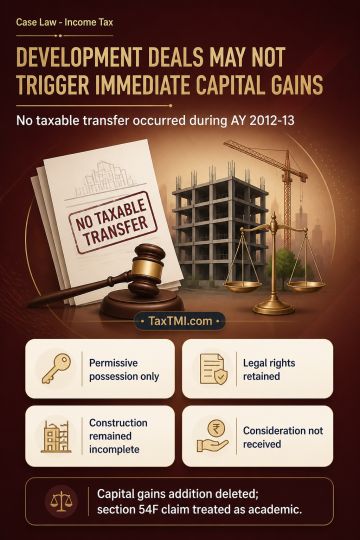
Development agreements require legal possession or effective enjoyment for capital gains transfer; permissive possession and deferred consideration de...
Prolonged sterilisation of development rights supports capital-gains treatment, while business-income disallowances cannot govern capital-gains comput...
Additional evidence in transfer pricing dispute leads to fresh examination, while tax deductions, TDS credit, fee and refund interest require verifica...
Category II AIF pass-through taxation preserves non-business income character; investment receipts cannot be reclassified without applying recognised ...
Arbitration agreement - Applicability on the party who is not the signatory of the agreement - Scope of Section 9 of the Arbitration and Conciliation Act, 1996 - The distinction between the powers under Section 9 of the Act and Section 17 of the Act has a clear rationale. An Arbitrator is a creature of the contract between the parties and therefore cannot venture outside the contract to issue directions to parties who are non-parties to the Arbitration Agreement. This limitation is not applicable to a Court exercising power under Section 9 of the Act.
Arbitration agreement - Applicability on the party who is not the signatory of the agreement - Scope of Section 9 of the Arbitration and Conciliation Act, 1996 - The distinction between the powers under Section 9 of the Act and Section 17 of the Act has a clear rationale. An Arbitrator is a creature of the contract between the parties and therefore cannot venture outside the contract to issue directions to parties who are non-parties to the Arbitration Agreement. This limitation is not applicable to a Court exercising power under Section 9 of the Act.
Note: It is a system-generated summary and is for quick reference only.
 TaxTMI
 of 4801











 Join Channel


 TaxTMI

