Inherited property sale proceeds require capital-gains treatment where ownership is supported by evidence, not suspicion or unverified signature doubt...
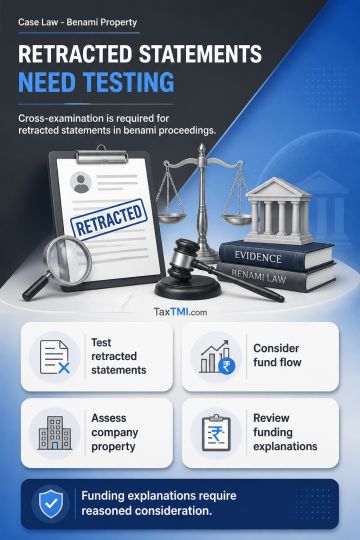
Cross-examination of retracted statements is essential where foundational evidence supports a benami allegation and documented funding explanations re...
Capital-goods exemption covers plant-modernisation accessories, while the import restriction applies only to earlier capital-goods components and spar...
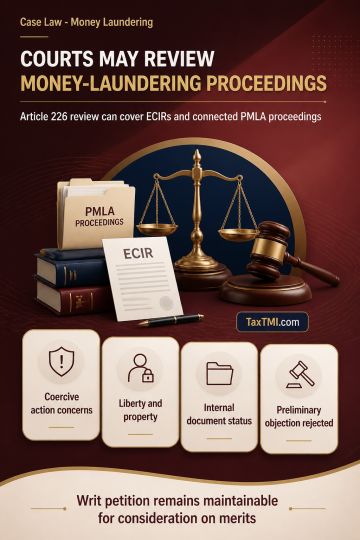
Constitutional judicial review permits challenges to ECIRs and connected money-laundering proceedings where coercive action affects fundamental intere...
Valuation - Distinction between "Normal Value" and "Transaction Value" - The observations made in paragraph 84 in the case of Acer India to the effect that ‘transaction value’ defined in Section 4(3)(d) of the Act would be subject to the charging provisions contained in Section 3 of the Act will have viewed in the context of a situation where an addition of the value of a non-dutiable item was sought to be made to the value of a dutiable item for the purpose of determination of the transaction value of the composite item. This is the limited context in which the subservience of Section 4(3)(d) to Section 3 of the Act was expressed and has to be understood. If so understood, we do not see how the views expressed in paragraph 84 of Acer India Ltd. (supra) can be read to be in conflict with the decision of Bombay Tyre International Ltd. (1983 (10) TMI 51 - SUPREME COURT OF INDIA). - SC
Valuation - Distinction between "Normal Value" and "Transaction Value" - The observations made in paragraph 84 in the case of Acer India to the effect that ‘transaction value’ defined in Section 4(3)(d) of the Act would be subject to the charging provisions contained in Section 3 of the Act will have viewed in the context of a situation where an addition of the value of a non-dutiable item was sought to be made to the value of a dutiable item for the purpose of determination of the transaction value of the composite item. This is the limited context in which the subservience of Section 4(3)(d) to Section 3 of the Act was expressed and has to be understood. If so understood, we do not see how the views expressed in paragraph 84 of Acer India Ltd. (supra) can be read to be in conflict with the decision of Bombay Tyre International Ltd. (1983 (10) TMI 51 - SUPREME COURT OF INDIA). - SC
Note: It is a system-generated summary and is for quick reference only.
 TaxTMI
 of 4786








 Join Channel


 TaxTMI