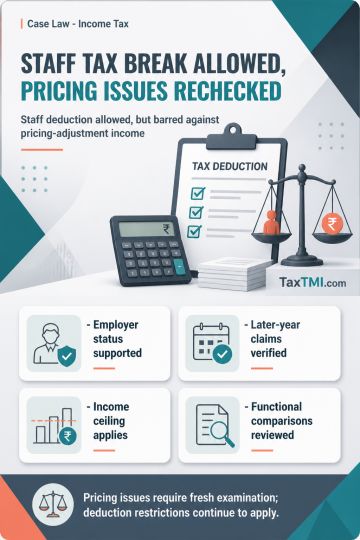
Section 80JJAA employee-cost deduction allowed for deployed staff but barred against transfer-pricing income enhancement, with pricing issues remanded...
Transfer-pricing methodology protects commercially genuine associated-enterprise payments, while pre-2016 secondary adjustments and related notional i...
Negative liens over operating assets can constitute international transactions requiring arm's-length pricing reflecting restricted borrowing and expa...
Cross-examination rights in Customs Broker revocation inquiries require witness examination; procedural denial may be cured through fresh adjudication...
Governmental authority status supports construction-service exemption, while pre-cutoff contract and stamp-duty compliance requires verification on re...
Page of 4826
Press 'Enter' after typing page number.
81 to 100 of 96510 Results
❮
❯
❯❯
0 / 200
Expand Note
Add to Folder
No Folders have been created
+
Are you sure you want to delete "My most important" ?
Third-party seized loose sheets can support an on-money addition only when corroborated or demonstrably connected to the assessee's business. Where flat-level particulars, cash receipts, the developer's role and offered profit established that connection, the Tribunal sustained the finding and quantification of on-money receipts, rejecting unsupported claims of duplicate entries, prior assessment and booking cancellations. As unaccounted real-estate receipts are business receipts, only their embedded profit is taxable; lacking a basis for a higher rate, the Tribunal reduced the estimated profit rate to 8 percent. No further telescoping was available because unaccounted expenditure had already been accepted as met from those receipts. Mere initiation of penalty proceedings was not appealable and the challenge was premature.
Third-party seized loose sheets can support an on-money addition only when corroborated or demonstrably connected to the assessee's business. Where flat-level particulars, cash receipts, the developer's role and offered profit established that connection, the Tribunal sustained the finding and quantification of on-money receipts, rejecting unsupported claims of duplicate entries, prior assessment and booking cancellations. As unaccounted real-estate receipts are business receipts, only their embedded profit is taxable; lacking a basis for a higher rate, the Tribunal reduced the estimated profit rate to 8 percent. No further telescoping was available because unaccounted expenditure had already been accepted as met from those receipts. Mere initiation of penalty proceedings was not appealable and the challenge was premature.
Note: It is a system-generated summary and is for quick reference only.
 TaxTMI
  TaxTMI
 of 4826






















 Join Channel