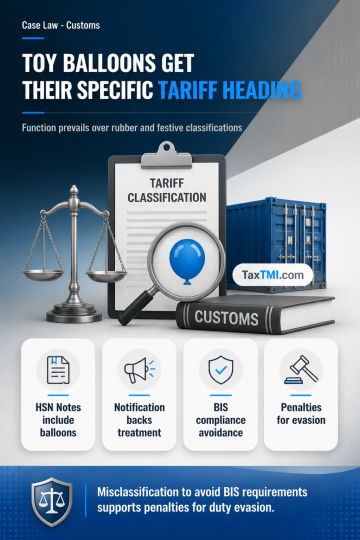
Toy balloon tariff classification: functional heading prevails over residual rubber and festive article headings, supporting penalties for deliberate ...
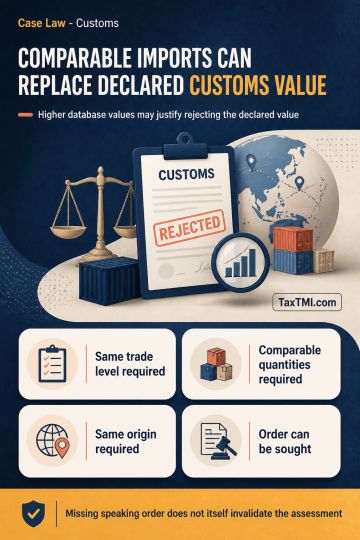
Customs valuation using comparable contemporaneous imports can displace declared value, while missing speaking orders require pursuit before competent...
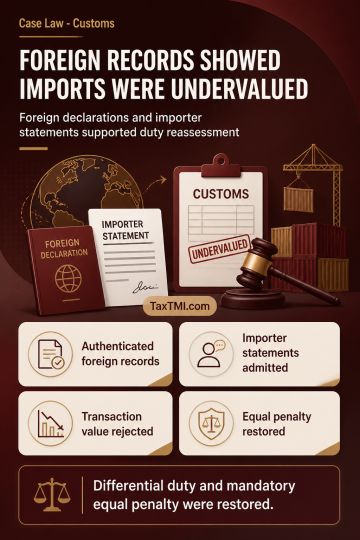
Foreign customs declarations and importer admissions established undervaluation, supporting sequential value redetermination, differential duty, and m...
Customs seizure safeguards prevent detention-based limitation avoidance and invalidate provisional release conditions for imported vehicles under an i...
Page of 4828
Press 'Enter' after typing page number.
361 to 380 of 96556 Results
❮
❯
❯❯
0 / 200
Expand Note
Add to Folder
No Folders have been created
+
Are you sure you want to delete "My most important" ?
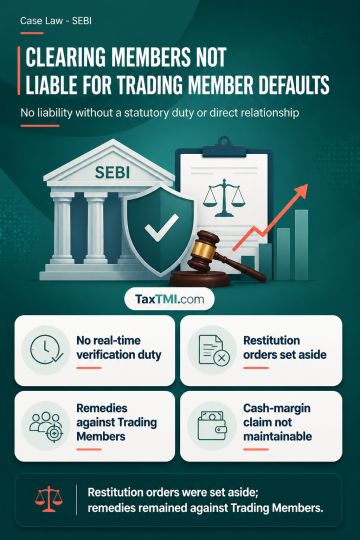
Professional Clearing Members had no statutory duty or real-time regulatory visibility to verify individual Trading Member clients' debit and credit positions before collateral liquidation; the applicable framework treated the Trading Member as their constituent and restricted cross-use of margin only between Trading Members. No regulatory breach was established. Clearing committees could not order restitution of liquidated securities or block equivalent collateral, because stock-exchange bye-laws excluded monetary penalties and no substantive statutory power supported those measures. Individual clients had no claim against Professional Clearing Members for Trading Members' defaults under illegal assured-return schemes, absent privity or regulatory breach; remedies remained against Trading Members. Restitution orders were set aside, while the investor's cash-margin claim was not maintainable.
Professional Clearing Members had no statutory duty or real-time regulatory visibility to verify individual Trading Member clients' debit and credit positions before collateral liquidation; the applicable framework treated the Trading Member as their constituent and restricted cross-use of margin only between Trading Members. No regulatory breach was established. Clearing committees could not order restitution of liquidated securities or block equivalent collateral, because stock-exchange bye-laws excluded monetary penalties and no substantive statutory power supported those measures. Individual clients had no claim against Professional Clearing Members for Trading Members' defaults under illegal assured-return schemes, absent privity or regulatory breach; remedies remained against Trading Members. Restitution orders were set aside, while the investor's cash-margin claim was not maintainable.
Note: It is a system-generated summary and is for quick reference only.
 TaxTMI
  TaxTMI
 of 4828









 Join Channel