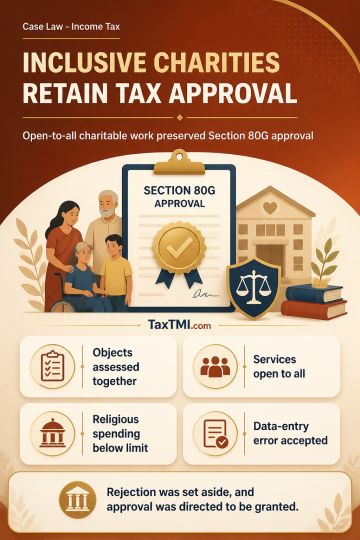
Original works exemption excludes standalone boulder transportation, leaving subcontracted railway-project transport services subject to service tax l...
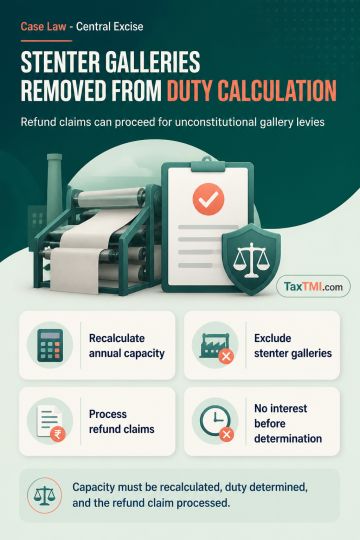
Annual production capacity determinations excluding stenter galleries support refunds for unconstitutional excise levies without an unjust-enrichment ...
Vicarious liability for cheque dishonour requires specific allegations of responsibility and cheque signatory; generic director allegations cannot sus...
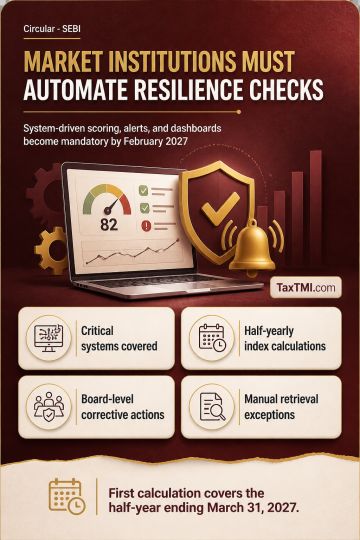
IT Resilience Index requires market infrastructure institutions to automate resilience scoring, early warnings, and continuous service-delivery monito...
Section 80G approval turns on an institution's objects,...
Charitable character assessment preserves Section 80G approval despite inclusive spiritual teachings and incidental religious expenditure within the statutory limit.
Contents
Summary
Note
Bookmark
Share
✓ Copied successfully !
Print
Print Options
For full text, please login
Login to TaxTMI
Verification Pending
The Email Id has not been verified. Click on the link we have sent on
Section 80G approval turns on an institution's objects, beneficiaries and activities considered as a whole, rather than isolated spiritual or philosophical clauses. Disseminating Bhagavad Gita teachings alongside relief of poverty, medical relief, public welfare, libraries and reading rooms does not make a society wholly or substantially religious where membership and services are open to all communities. Religious-expenditure entries in Form 10AB that duplicated total audited expenditure, despite a declaration of no religious spending, were treated as an inadvertent data-entry error rather than a substantive admission. In any event, incidental religious expenditure below the five per cent statutory ceiling does not defeat eligibility. The rejection was set aside and approval was directed to be granted.
Section 80G approval turns on an institution's objects, beneficiaries and activities considered as a whole, rather than isolated spiritual or philosophical clauses. Disseminating Bhagavad Gita teachings alongside relief of poverty, medical relief, public welfare, libraries and reading rooms does not make a society wholly or substantially religious where membership and services are open to all communities. Religious-expenditure entries in Form 10AB that duplicated total audited expenditure, despite a declaration of no religious spending, were treated as an inadvertent data-entry error rather than a substantive admission. In any event, incidental religious expenditure below the five per cent statutory ceiling does not defeat eligibility. The rejection was set aside and approval was directed to be granted.
Note: It is a system-generated summary and is for quick reference only.
 TaxTMI
  TaxTMI
 of 4821









 Join Channel