Educational approval requires mandatory State registration, but incidental surplus and trustee-owned land do not prove private benefit or profit motiv...
Judicial review of settlement orders cannot reopen settled customs notices, while statutory interest remains subject to verification and quantificatio...
Customs Broker licence lending for consideration justified revocation where exporter authorisation and client verification obligations were also breac...
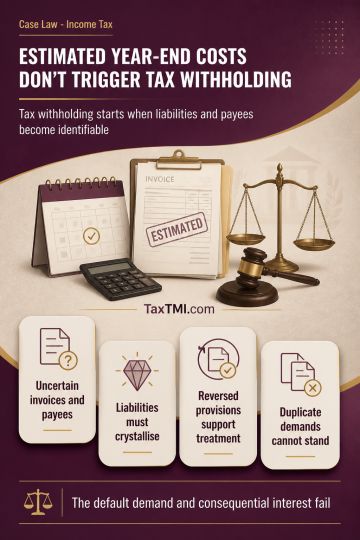
Year-end estimated expenditure provisions, where invoices, precise liabilities and payees remain unascertained, do not amount to credit of an ascertainable sum to an identified payee under the mercantile system. Tax-deduction obligations therefore arise only when liabilities crystallise, with tax deducted where applicable upon receipt of invoices; reversal of the provisions in the succeeding year supports that treatment. A demand for tax-deduction default cannot be sustained merely on creation of such provisions. Further, where the same non-deduction has already led to disallowance of expenditure, it cannot also support a tax-deduction default demand; consequential interest fails with the principal demand.
Year-end estimated expenditure provisions, where invoices, precise liabilities and payees remain unascertained, do not amount to credit of an ascertainable sum to an identified payee under the mercantile system. Tax-deduction obligations therefore arise only when liabilities crystallise, with tax deducted where applicable upon receipt of invoices; reversal of the provisions in the succeeding year supports that treatment. A demand for tax-deduction default cannot be sustained merely on creation of such provisions. Further, where the same non-deduction has already led to disallowance of expenditure, it cannot also support a tax-deduction default demand; consequential interest fails with the principal demand.
Note: It is a system-generated summary and is for quick reference only.
 TaxTMI
  TaxTMI
 of 4821













 Join Channel