Cash-method accounting bars presumptive interest taxation, while unsupported securities and share-trading additions require reliable material and veri...
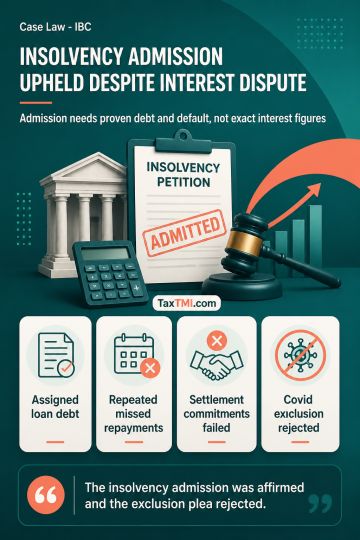
Section 7 admission requires established financial debt and default, not precise interest quantification, while post-suspension defaults remain action...
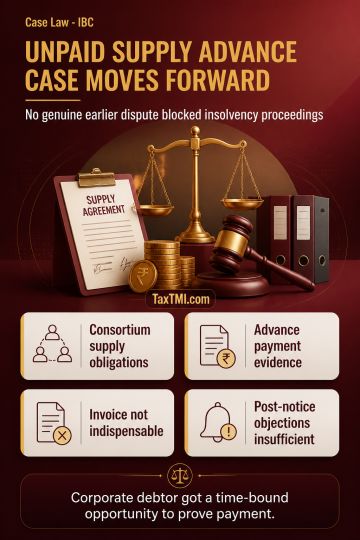
Operational debt may arise from an advance paid for goods where a consortium agreement assigns supply obligations to the corporate debtor and other evidence establishes the commercial nexus; an invoice is not indispensable. Receipt of the advance, cheques issued by the corporate debtor, and a later withdrawn invoice supported characterisation as payment for supplies rather than an unsupported security deposit. A pre-existing dispute must exist before the demand notice; post-notice objections and account-reconciliation assertions do not suffice. The insolvency application was revived for admission, subject to a time-bound opportunity for the corporate debtor to prove payment.
Operational debt may arise from an advance paid for goods where a consortium agreement assigns supply obligations to the corporate debtor and other evidence establishes the commercial nexus; an invoice is not indispensable. Receipt of the advance, cheques issued by the corporate debtor, and a later withdrawn invoice supported characterisation as payment for supplies rather than an unsupported security deposit. A pre-existing dispute must exist before the demand notice; post-notice objections and account-reconciliation assertions do not suffice. The insolvency application was revived for admission, subject to a time-bound opportunity for the corporate debtor to prove payment.
Note: It is a system-generated summary and is for quick reference only.
 TaxTMI
  TaxTMI
 of 4824











 Join Channel