Educational approval requires mandatory State registration, but incidental surplus and trustee-owned land do not prove private benefit or profit motiv...
Banks may identify and report suspicious transactions but cannot...
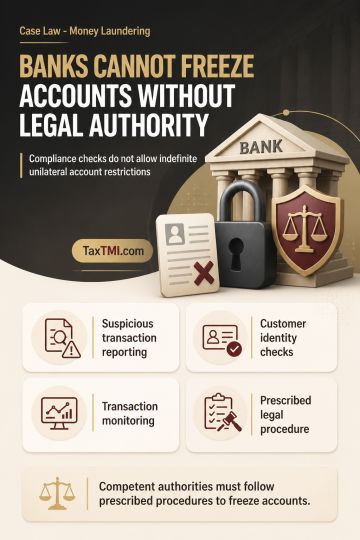
Bank account freezing requires statutory authority; anti-money-laundering compliance and KYC monitoring do not permit unilateral indefinite restrictions.
Contents
Summary
Note
Bookmark
Share
✓ Copied successfully !
Print
Print Options
For full text, please login
Login to TaxTMI
Verification Pending
The Email Id has not been verified. Click on the link we have sent on
Banks may identify and report suspicious transactions but cannot unilaterally freeze customer accounts without statutory authority. Section 12AA of the Prevention of Money Laundering Act permits identity verification, record examination and information requisition as compliance measures; it does not grant investigative or adjudicatory powers to freeze accounts. RBI KYC Directions similarly require customer due diligence, information collection, transaction monitoring and regulatory reporting, rather than indefinite freezing based solely on transaction volume. Property attachment and account-freezing powers lie with competent authorities acting under prescribed legal procedure.
Banks may identify and report suspicious transactions but cannot unilaterally freeze customer accounts without statutory authority. Section 12AA of the Prevention of Money Laundering Act permits identity verification, record examination and information requisition as compliance measures; it does not grant investigative or adjudicatory powers to freeze accounts. RBI KYC Directions similarly require customer due diligence, information collection, transaction monitoring and regulatory reporting, rather than indefinite freezing based solely on transaction volume. Property attachment and account-freezing powers lie with competent authorities acting under prescribed legal procedure.
Note: It is a system-generated summary and is for quick reference only.
 TaxTMI
  TaxTMI
 of 4817















 Join Channel