Online bond platforms may offer overseas-regulated products and tax-specific bonds subject to disclosures, compliance safeguards and revised complianc...
Corporate guarantee valuation permits actual ascertainable commission while barring retroactive application and extended-period penalties for bona fid...
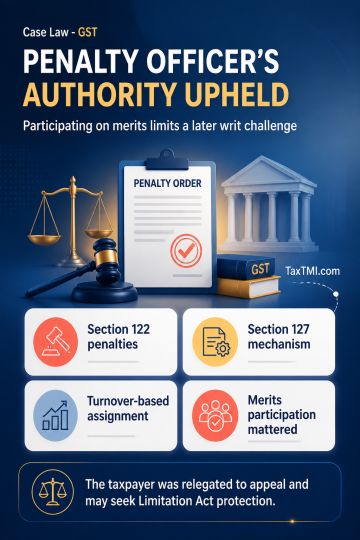
Proper-officer jurisdiction under UPGST penalty provisions upheld; participation on merits prevents bypassing the statutory appellate remedy through w...
Transitioned CENVAT credit may validly satisfy mandatory pre-deposit requirements for legacy service tax appeals through Electronic Credit Ledger debi...
Building-plan sanction charges require statutory authority; unauthorised fees and GST were quashed, while labour cess must follow prescribed collectio...
Pure-agent exclusion fails where hotel booking facilitators receive third-party services themselves, making entire customer consideration taxable as r...
Transfer pricing requires evidence for AMP transactions, functionally reliable comparables, and appropriate aggregation or Berry Ratio benchmarking me...
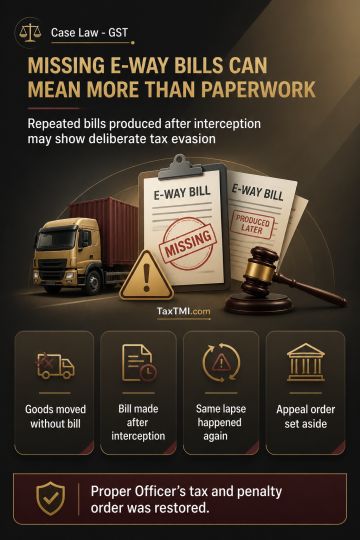
Transportation of taxable goods without an E-Way Bill is treated as substantive non-compliance where the bill is generated only after interception and the same lapse recurs. An E-Way Bill forms part of the statutory mechanism for monitoring taxable-goods movement; its absence alongside a manually issued invoice may permit subsequent account manipulation. Post-interception production, combined with repetition in a similar transaction, indicates a deliberate course of conduct and intention to evade tax rather than a technical or procedural breach. On that basis, tax and penalty proceedings were sustained, the first appellate order was set aside, and the Proper Officer's tax and penalty order was restored.
Transportation of taxable goods without an E-Way Bill is treated as substantive non-compliance where the bill is generated only after interception and the same lapse recurs. An E-Way Bill forms part of the statutory mechanism for monitoring taxable-goods movement; its absence alongside a manually issued invoice may permit subsequent account manipulation. Post-interception production, combined with repetition in a similar transaction, indicates a deliberate course of conduct and intention to evade tax rather than a technical or procedural breach. On that basis, tax and penalty proceedings were sustained, the first appellate order was set aside, and the Proper Officer's tax and penalty order was restored.
Note: It is a system-generated summary and is for quick reference only.
 TaxTMI
  TaxTMI
 of 4817
















 Join Channel