Educational approval requires mandatory State registration, but incidental surplus and trustee-owned land do not prove private benefit or profit motiv...
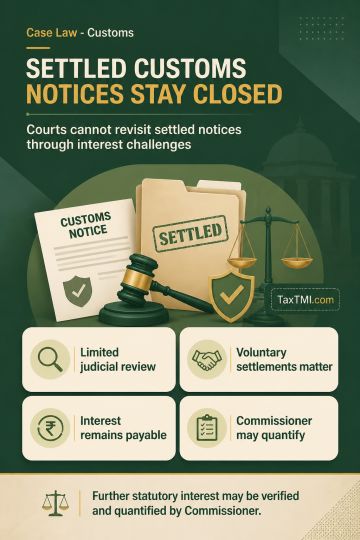
Judicial review of settlement orders cannot reopen settled customs notices, while statutory interest remains subject to verification and quantificatio...
Customs Broker licence lending for consideration justified revocation where exporter authorisation and client verification obligations were also breac...
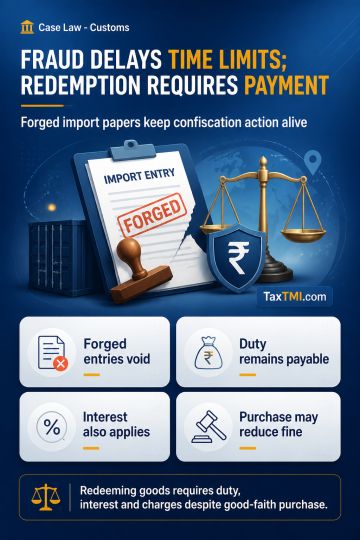
Fraudulent import documents suspend limitation protection, while redemption of confiscated goods requires duty and interest despite bona fide purchase...
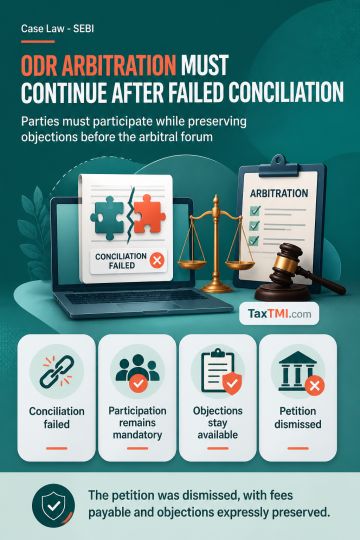
ODR arbitration participation remains mandatory after failed conciliation, while jurisdictional and maintainability objections stay available before t...
Page of 4814
Press 'Enter' after typing page number.
141 to 160 of 96262 Results
❮
❯
❯❯
0 / 200
Expand Note
Add to Folder
No Folders have been created
+
Are you sure you want to delete "My most important" ?
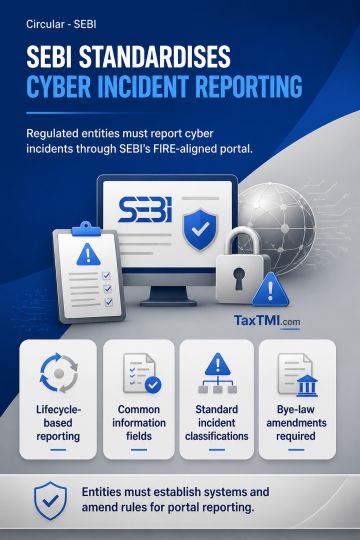
Cyber incident reporting by regulated entities must be made through SEBI's Cyber Incident Reporting Portal, aligned with the Financial Stability Board's Format for Incident Reporting Exchange (FIRE). The aligned portal requires structured reporting using common information fields, standard definitions and consistent incident classifications, supporting harmonised reporting. It permits reporting across the incident lifecycle, including initial notification, intermediate updates and final closure, recognising that complete information may not be available initially. Regulated entities must establish systems to implement the portal-based reporting requirement and make any necessary amendments to their bye-laws, rules or regulations. The requirement operates alongside applicable cybersecurity and cyber-resilience reporting obligations.
Cyber incident reporting by regulated entities must be made through SEBI's Cyber Incident Reporting Portal, aligned with the Financial Stability Board's Format for Incident Reporting Exchange (FIRE). The aligned portal requires structured reporting using common information fields, standard definitions and consistent incident classifications, supporting harmonised reporting. It permits reporting across the incident lifecycle, including initial notification, intermediate updates and final closure, recognising that complete information may not be available initially. Regulated entities must establish systems to implement the portal-based reporting requirement and make any necessary amendments to their bye-laws, rules or regulations. The requirement operates alongside applicable cybersecurity and cyber-resilience reporting obligations.
Note: It is a system-generated summary and is for quick reference only.
 TaxTMI
  TaxTMI
 of 4814











 Join Channel