Business expenditure deduction requires proof of genuine commission payments and commercial allowability; turnover growth alone cannot validate the cl...
Article 8 treaty coverage excluded third-party airline support services, while documented demonetisation cash receipts remained accepted business inco...
Functional comparability under TNMM requires highway contract benchmarks to reflect operation, maintenance and transfer activities, requiring fresh be...
Objective characteristics govern magnesium bis-glycinate chelate classification as an amino-acid coordination compound, not a food preparation or anti...
Page of 4821
Press 'Enter' after typing page number.
941 to 960 of 96406 Results
❮
❯
❯❯
0 / 200
Expand Note
Add to Folder
No Folders have been created
+
Are you sure you want to delete "My most important" ?
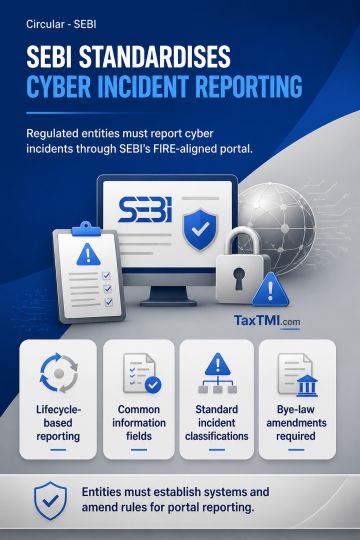
Cyber incident reporting by regulated entities must be made through SEBI's Cyber Incident Reporting Portal, aligned with the Financial Stability Board's Format for Incident Reporting Exchange (FIRE). The aligned portal requires structured reporting using common information fields, standard definitions and consistent incident classifications, supporting harmonised reporting. It permits reporting across the incident lifecycle, including initial notification, intermediate updates and final closure, recognising that complete information may not be available initially. Regulated entities must establish systems to implement the portal-based reporting requirement and make any necessary amendments to their bye-laws, rules or regulations. The requirement operates alongside applicable cybersecurity and cyber-resilience reporting obligations.
Cyber incident reporting by regulated entities must be made through SEBI's Cyber Incident Reporting Portal, aligned with the Financial Stability Board's Format for Incident Reporting Exchange (FIRE). The aligned portal requires structured reporting using common information fields, standard definitions and consistent incident classifications, supporting harmonised reporting. It permits reporting across the incident lifecycle, including initial notification, intermediate updates and final closure, recognising that complete information may not be available initially. Regulated entities must establish systems to implement the portal-based reporting requirement and make any necessary amendments to their bye-laws, rules or regulations. The requirement operates alongside applicable cybersecurity and cyber-resilience reporting obligations.
Note: It is a system-generated summary and is for quick reference only.
 TaxTMI
  TaxTMI
 of 4821











 Join Channel