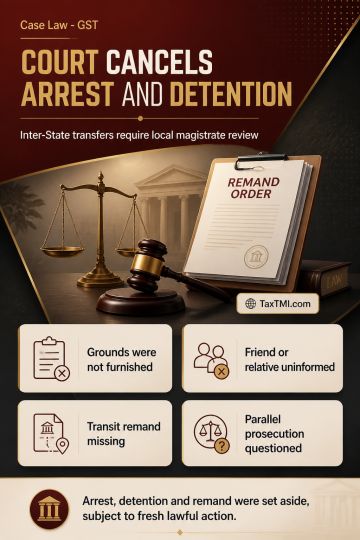
Arrest safeguards and transit remand requirements invalidated detention following inter-State transfer without communicated grounds or magistrate auth...
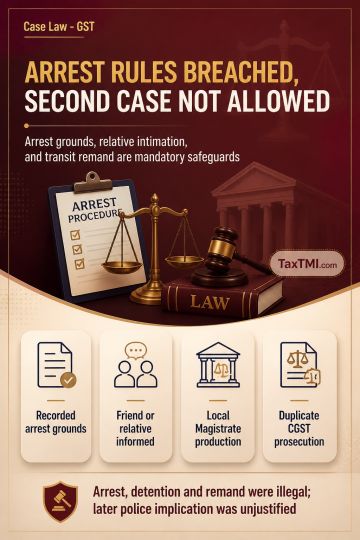
Arrest safeguards require disclosed grounds, relative intimation and transit remand, while duplicate prosecution under the CGST framework is unsustain...
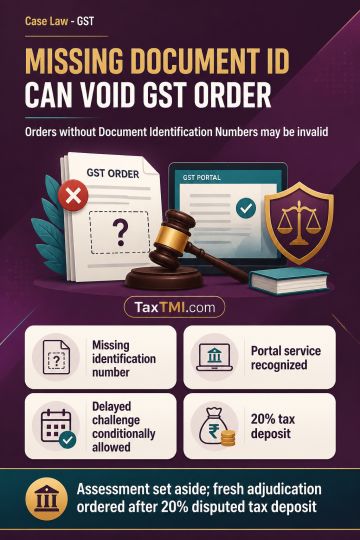
Document Identification Number defects can invalidate GST assessments, with delayed challenges entertained conditionally where patent irregularities e...
Windmill commissioning evidence supported higher depreciation where grid connection and electricity generation proved operational use before the relev...
Market Infrastructure Institutions must implement a...
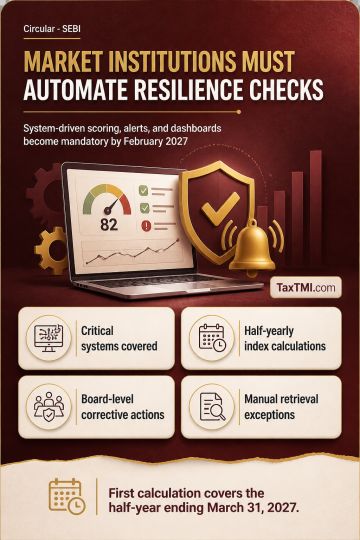
IT Resilience Index requires market infrastructure institutions to automate resilience scoring, early warnings, and continuous service-delivery monitoring.
Contents
Summary
Note
Bookmark
Share
✓ Copied successfully !
Print
Print Options
For full text, please login
Login to TaxTMI
Verification Pending
The Email Id has not been verified. Click on the link we have sent on
Market Infrastructure Institutions must implement a system-driven IT Resilience Index to measure the robustness of critical IT systems and related systems. The Index covers availability, security, integrity, governance, reliability and monitoring, business continuity, modularity and flexibility, scalability, and incident handling. Institutions must compute the Index half-yearly, submit comparative results and corrective actions to their technology committee and governing board, and limit manual data retrieval to exceptions discussed with the technology committee. They must also establish an early warning system, continuous service-delivery dashboards, and monitoring procedures. The framework, including early warning and real-time monitoring, must be operational by February 28, 2027, with the first computation for the half-year ending March 31, 2027.
Market Infrastructure Institutions must implement a system-driven IT Resilience Index to measure the robustness of critical IT systems and related systems. The Index covers availability, security, integrity, governance, reliability and monitoring, business continuity, modularity and flexibility, scalability, and incident handling. Institutions must compute the Index half-yearly, submit comparative results and corrective actions to their technology committee and governing board, and limit manual data retrieval to exceptions discussed with the technology committee. They must also establish an early warning system, continuous service-delivery dashboards, and monitoring procedures. The framework, including early warning and real-time monitoring, must be operational by February 28, 2027, with the first computation for the half-year ending March 31, 2027.
Note: It is a system-generated summary and is for quick reference only.
 TaxTMI
  TaxTMI
 of 4819










 Join Channel