Business expenditure deduction requires proof of genuine commission payments and commercial allowability; turnover growth alone cannot validate the cl...
Article 8 treaty coverage excluded third-party airline support services, while documented demonetisation cash receipts remained accepted business inco...
Functional comparability under TNMM requires highway contract benchmarks to reflect operation, maintenance and transfer activities, requiring fresh be...
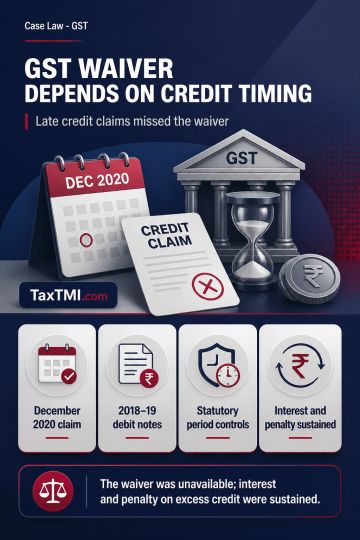
GST amnesty waiver eligibility for interest and penalty depends on the disputed input tax credit being availed within the prescribed statutory period, rather than on the financial year in which the underlying debit notes were issued. Excess credit first claimed in the December 2020 return fell outside the scheme's temporal scope despite its connection with debit notes from 2018-19. Guidance or decisions concerning input tax credit mismatch reconciliation cannot extend an expressly limited statutory period. The waiver was unavailable, and the interest and penalty on the excess credit claim were sustained.
GST amnesty waiver eligibility for interest and penalty depends on the disputed input tax credit being availed within the prescribed statutory period, rather than on the financial year in which the underlying debit notes were issued. Excess credit first claimed in the December 2020 return fell outside the scheme's temporal scope despite its connection with debit notes from 2018-19. Guidance or decisions concerning input tax credit mismatch reconciliation cannot extend an expressly limited statutory period. The waiver was unavailable, and the interest and penalty on the excess credit claim were sustained.
Note: It is a system-generated summary and is for quick reference only.
 TaxTMI
  TaxTMI
 of 4821
















 Join Channel