Opportunity to respond to jurisdictional reports is mandatory before customs settlement duty enhancement; connected applications require consistent ad...
Specific customs headings for scaffolding components prevail over general classification, invalidating misclassification proceedings and enabling with...
Liquidator appointment under Section 34 requires consideration of creditor recommendations, valid professional authorisation, and preservation of vali...
Income-tax exemption for specified regulatory fees and government grants applies subject to non-commercial activity and continuing compliance conditio...
Digital accessibility audit and remediation deadlines extended, while all other disability-compliance obligations for regulated entities remain unchan...
Transfer pricing requires selection of the most appropriate...
Transfer pricing comparability prioritises reliable external CUPs and foreign-currency LIBOR benchmarks for exports, borrowings and delayed receivables.
Contents
Summary
Note
Bookmark
Share
✓ Copied successfully !
Print
Print Options
For full text, please login
Login to TaxTMI
Verification Pending
The Email Id has not been verified. Click on the link we have sent on
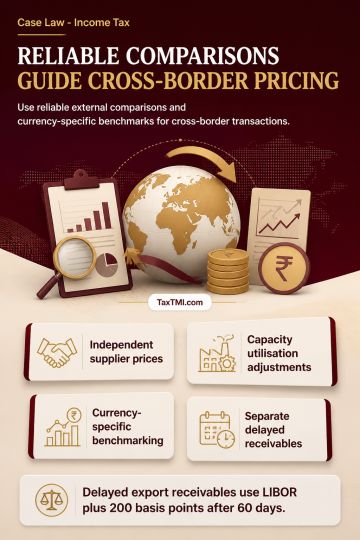
Transfer pricing requires selection of the most appropriate method based on transaction nature and comparable-data reliability, with neither CUP nor TNMM having statutory priority. An external CUP based on an associated enterprise's purchases from independent suppliers may be reliable where geographic, volume or timing differences do not materially affect price or can be reasonably adjusted. TNMM may be unreliable without meaningful adjustment for abnormal fixed costs from low capacity utilisation. Foreign-currency borrowings and receivables require currency-specific benchmarking under comparable uncontrolled conditions. Delayed export receivables constitute separate international transactions, with interest benchmarked at LIBOR plus 200 basis points after a 60-day credit period.
Transfer pricing requires selection of the most appropriate method based on transaction nature and comparable-data reliability, with neither CUP nor TNMM having statutory priority. An external CUP based on an associated enterprise's purchases from independent suppliers may be reliable where geographic, volume or timing differences do not materially affect price or can be reasonably adjusted. TNMM may be unreliable without meaningful adjustment for abnormal fixed costs from low capacity utilisation. Foreign-currency borrowings and receivables require currency-specific benchmarking under comparable uncontrolled conditions. Delayed export receivables constitute separate international transactions, with interest benchmarked at LIBOR plus 200 basis points after a 60-day credit period.
Note: It is a system-generated summary and is for quick reference only.
 TaxTMI
  TaxTMI
 of 4821






















 Join Channel