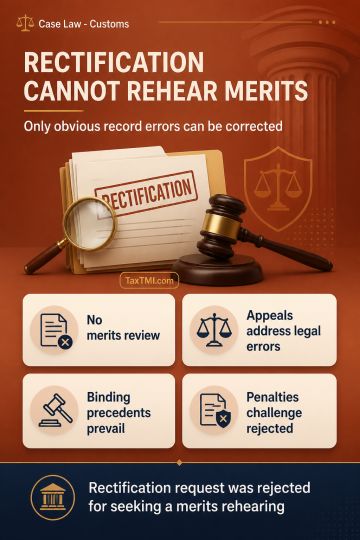
Rectification of mistake remains limited to self-evident record errors, preventing merits review through miscellaneous applications and preserving fin...
Tender creditworthiness conditions may extend to de facto Promoter Directors, with post-participation challenges generally barred absent arbitrariness...
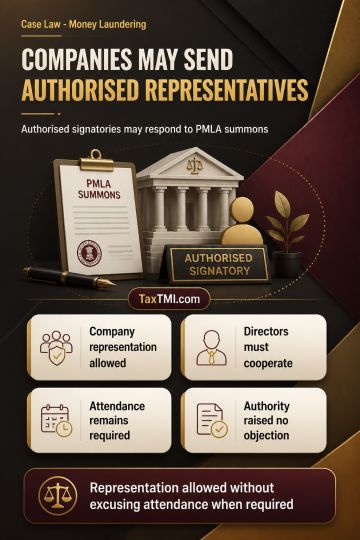
Corporate representation in PMLA summons proceedings permitted through an authorised signatory, subject to directors' continuing cooperation and atten...
Helicopter charter classification requires effective control analysis, while territorial performance, reasoned credit orders and wilful suppression de...
Specified fund definition expands PAN exemption eligibility for registered alternative investment funds and qualifying International Financial Service...
Tax exemption for specified legal-services authority income applies retrospectively, subject to non-commercial activity, unchanged income sources, and...
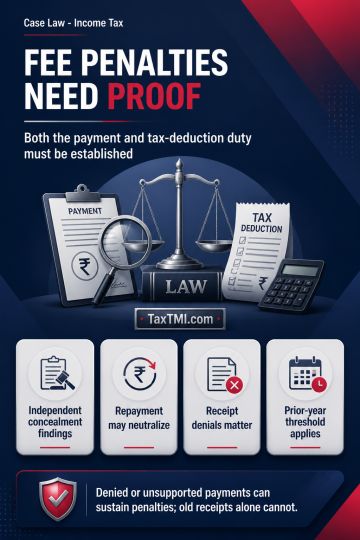
Penalty for inaccurate particulars in professional-fee claims requires substantiated expenditure and independent findings supporting concealment or inaccurate particulars. A payment characterised as professional fees but shown to be a loan advanced and repaid, with a corresponding receipt credited to profit and loss, is revenue neutral and does not support disallowance or penalty. Conversely, penalty remains justified where claimed payees deny receipt or payments remain unsubstantiated. Liability to deduct tax on professional fees depends on satisfying the statutory threshold based on gross receipts in the immediately preceding financial year; older receipt data alone is insufficient. Disallowance for non-deduction of tax does not, by itself, justify penalty.
Penalty for inaccurate particulars in professional-fee claims requires substantiated expenditure and independent findings supporting concealment or inaccurate particulars. A payment characterised as professional fees but shown to be a loan advanced and repaid, with a corresponding receipt credited to profit and loss, is revenue neutral and does not support disallowance or penalty. Conversely, penalty remains justified where claimed payees deny receipt or payments remain unsubstantiated. Liability to deduct tax on professional fees depends on satisfying the statutory threshold based on gross receipts in the immediately preceding financial year; older receipt data alone is insufficient. Disallowance for non-deduction of tax does not, by itself, justify penalty.
Note: It is a system-generated summary and is for quick reference only.
 TaxTMI
  TaxTMI
 of 4821















 Join Channel