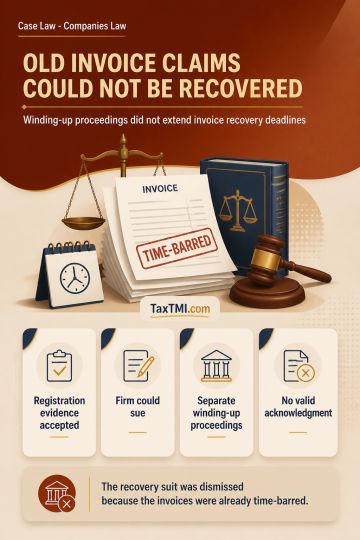
Invoice-based recovery claims remain time-barred despite separate winding-up proceedings, absent valid acknowledgment or part-payment of the disputed ...
Extended limitation fails without specific suppression allegations, while overseas employee secondment remains taxable as manpower supply within norma...
Time-share accommodation classification excludes Club or Association Service where purchasers receive contractual occupancy rights without genuine mem...
CENVAT credit for trading requires reversal, while taxable-service rental credit remains proportionately available and limitation issues await resolut...
Page of 4817
Press 'Enter' after typing page number.
561 to 580 of 96333 Results
❮
❯
❯❯
0 / 200
Expand Note
Add to Folder
No Folders have been created
+
Are you sure you want to delete "My most important" ?
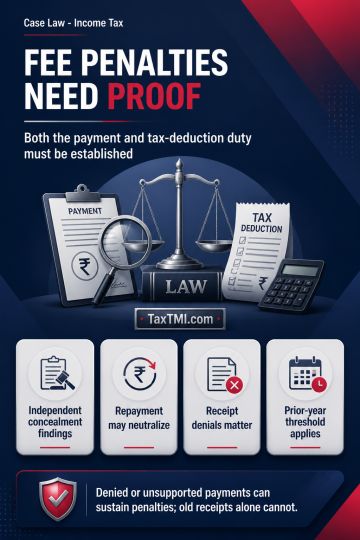
Penalty for inaccurate particulars in professional-fee claims requires substantiated expenditure and independent findings supporting concealment or inaccurate particulars. A payment characterised as professional fees but shown to be a loan advanced and repaid, with a corresponding receipt credited to profit and loss, is revenue neutral and does not support disallowance or penalty. Conversely, penalty remains justified where claimed payees deny receipt or payments remain unsubstantiated. Liability to deduct tax on professional fees depends on satisfying the statutory threshold based on gross receipts in the immediately preceding financial year; older receipt data alone is insufficient. Disallowance for non-deduction of tax does not, by itself, justify penalty.
Penalty for inaccurate particulars in professional-fee claims requires substantiated expenditure and independent findings supporting concealment or inaccurate particulars. A payment characterised as professional fees but shown to be a loan advanced and repaid, with a corresponding receipt credited to profit and loss, is revenue neutral and does not support disallowance or penalty. Conversely, penalty remains justified where claimed payees deny receipt or payments remain unsubstantiated. Liability to deduct tax on professional fees depends on satisfying the statutory threshold based on gross receipts in the immediately preceding financial year; older receipt data alone is insufficient. Disallowance for non-deduction of tax does not, by itself, justify penalty.
Note: It is a system-generated summary and is for quick reference only.
 TaxTMI
  TaxTMI
 of 4817
















 Join Channel