Charitable registration renewal cannot become an assessment of receipts, profitability or annual exemption compliance, requiring renewal and donation ...
AMP expenditure for own business is not an international transaction without an associated-enterprise arrangement, eliminating transfer pricing adjust...
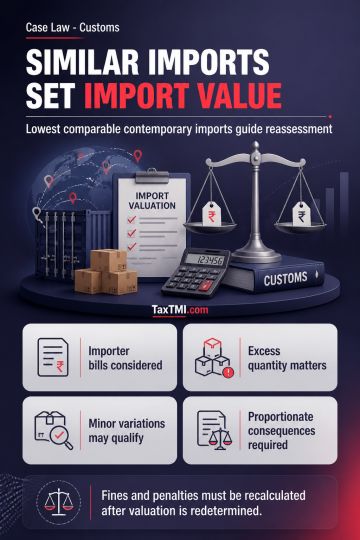
Customs valuation must use comparable contemporary imports, while confiscation fines and penalties require proportionate recalculation on reassessed v...
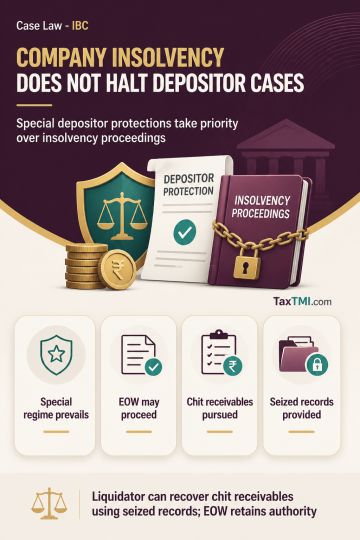
Depositor-protection proceedings prevail over corporate insolvency, while liquidators may recover chit receivables using copies of seized company reco...
Intermediary service classification fails where overseas admission facilitation is supplied independently, preserving export treatment and small-provi...
Satellite transponder bandwidth is telecommunication, not Business Support Service; foreign non-telegraph providers triggered no service tax liability...
Penalty for inaccurate particulars in professional-fee claims requires substantiated expenditure and independent findings supporting concealment or inaccurate particulars. A payment characterised as professional fees but shown to be a loan advanced and repaid, with a corresponding receipt credited to profit and loss, is revenue neutral and does not support disallowance or penalty. Conversely, penalty remains justified where claimed payees deny receipt or payments remain unsubstantiated. Liability to deduct tax on professional fees depends on satisfying the statutory threshold based on gross receipts in the immediately preceding financial year; older receipt data alone is insufficient. Disallowance for non-deduction of tax does not, by itself, justify penalty.
Penalty for inaccurate particulars in professional-fee claims requires substantiated expenditure and independent findings supporting concealment or inaccurate particulars. A payment characterised as professional fees but shown to be a loan advanced and repaid, with a corresponding receipt credited to profit and loss, is revenue neutral and does not support disallowance or penalty. Conversely, penalty remains justified where claimed payees deny receipt or payments remain unsubstantiated. Liability to deduct tax on professional fees depends on satisfying the statutory threshold based on gross receipts in the immediately preceding financial year; older receipt data alone is insufficient. Disallowance for non-deduction of tax does not, by itself, justify penalty.
Note: It is a system-generated summary and is for quick reference only.
 TaxTMI
  TaxTMI
 of 4814


















 Join Channel