Administrative fraud classification suspension does not halt independent criminal investigation or warrant-based searches into alleged economic offenc...
Arrest safeguards and transit remand requirements invalidated detention following inter-State transfer without communicated grounds or magistrate auth...
Arrest safeguards require disclosed grounds, relative intimation and transit remand, while duplicate prosecution under the CGST framework is unsustain...
Document Identification Number defects can invalidate GST assessments, with delayed challenges entertained conditionally where patent irregularities e...
Page of 4826
Press 'Enter' after typing page number.
1241 to 1260 of 96510 Results
❮
❯
❯❯
0 / 200
Expand Note
Add to Folder
No Folders have been created
+
Are you sure you want to delete "My most important" ?
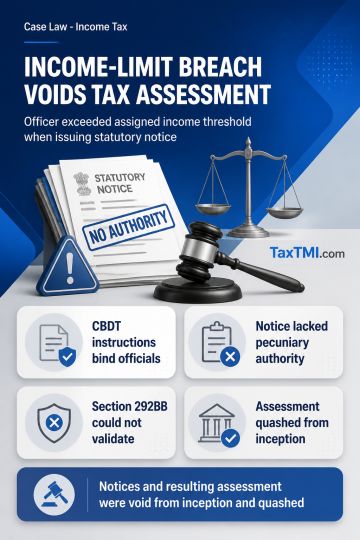
Pecuniary jurisdiction over statutory notices under section 143(2) must comply with CBDT instructions allocating cases by returned-income limits. Where an Income-tax Officer issues the notice despite the returned income exceeding that officer's prescribed limit, the defect concerns pecuniary rather than territorial jurisdiction; the territorial-jurisdiction objection rule does not apply. CBDT instructions bind the Department, and issue of a jurisdictional notice by an officer without pecuniary authority is an illegality, not a procedural irregularity capable of validation under section 292BB. The notices and consequential assessment were therefore treated as void from inception and quashed; other grounds remained academic.
Pecuniary jurisdiction over statutory notices under section 143(2) must comply with CBDT instructions allocating cases by returned-income limits. Where an Income-tax Officer issues the notice despite the returned income exceeding that officer's prescribed limit, the defect concerns pecuniary rather than territorial jurisdiction; the territorial-jurisdiction objection rule does not apply. CBDT instructions bind the Department, and issue of a jurisdictional notice by an officer without pecuniary authority is an illegality, not a procedural irregularity capable of validation under section 292BB. The notices and consequential assessment were therefore treated as void from inception and quashed; other grounds remained academic.
Note: It is a system-generated summary and is for quick reference only.
 TaxTMI
  TaxTMI
 of 4826



















 Join Channel