Donor-directed corpus contributions retain capital character despite exemption claims under section 10(23C)(vi), preventing their treatment as taxable...
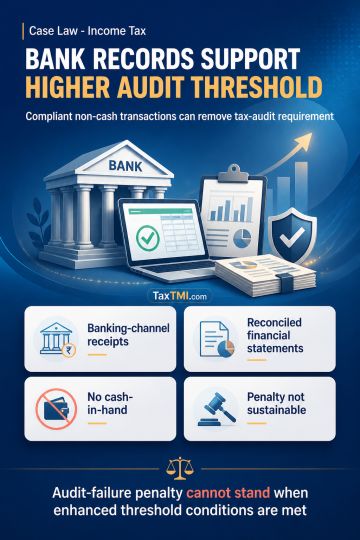
Enhanced tax-audit threshold applies where banking records establish compliant non-cash receipts and payments, eliminating penalty exposure for audit ...
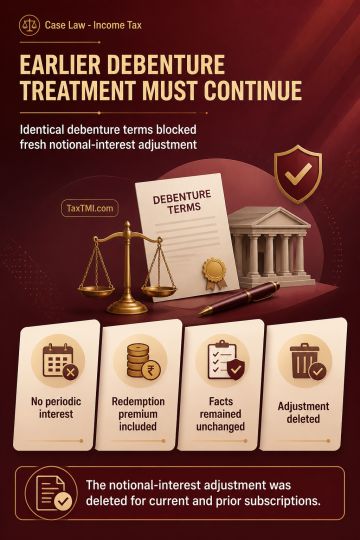
Transfer pricing consistency protects identical non-interest-bearing debenture terms from a later notional-interest adjustment without valid statutory...
Rectification of debatable deduction claims cannot reverse scrutiny-approved co-operative society interest income deductions as apparent record errors...
Cash-method accounting bars presumptive interest taxation, while unsupported securities and share-trading additions require reliable material and veri...
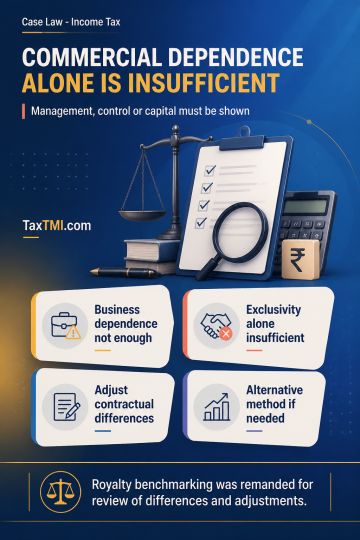
Sections 92A(1) and 92A(2) require a harmonious reading: the statutory circumstances in section 92A(2), including business dependence under section 92A(2)(g), do not independently establish an associated-enterprise relationship without participation in management, control or capital under section 92A(1). Commercial dependence or distribution exclusivity alone is insufficient absent evidence of ownership, voting rights, managerial participation or financial control. For internal CUP analysis, contractual differences do not disqualify an uncontrolled transaction unless they materially affect the royalty rate and cannot be eliminated through reasonably accurate, objectively verifiable adjustments. Royalty benchmarking was remanded to examine those differences and adjustments; if CUP is unreliable, the most appropriate method must be independently selected.
Sections 92A(1) and 92A(2) require a harmonious reading: the statutory circumstances in section 92A(2), including business dependence under section 92A(2)(g), do not independently establish an associated-enterprise relationship without participation in management, control or capital under section 92A(1). Commercial dependence or distribution exclusivity alone is insufficient absent evidence of ownership, voting rights, managerial participation or financial control. For internal CUP analysis, contractual differences do not disqualify an uncontrolled transaction unless they materially affect the royalty rate and cannot be eliminated through reasonably accurate, objectively verifiable adjustments. Royalty benchmarking was remanded to examine those differences and adjustments; if CUP is unreliable, the most appropriate method must be independently selected.
Note: It is a system-generated summary and is for quick reference only.
 TaxTMI
  TaxTMI
 of 4809

















 Join Channel