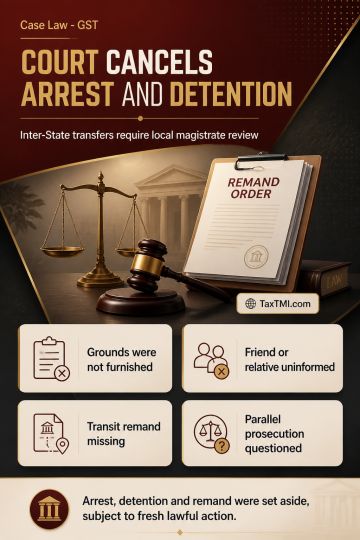
Arrest safeguards and transit remand requirements invalidated detention following inter-State transfer without communicated grounds or magistrate auth...
Arrest safeguards require disclosed grounds, relative intimation and transit remand, while duplicate prosecution under the CGST framework is unsustain...
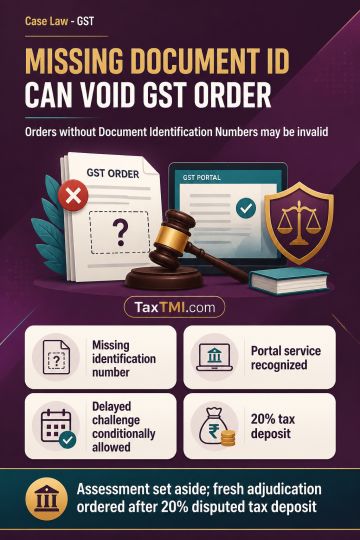
Document Identification Number defects can invalidate GST assessments, with delayed challenges entertained conditionally where patent irregularities e...
Windmill commissioning evidence supported higher depreciation where grid connection and electricity generation proved operational use before the relev...
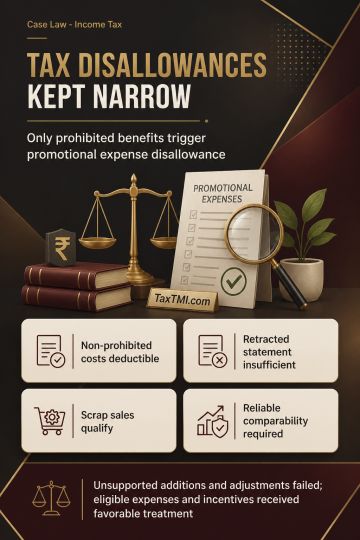
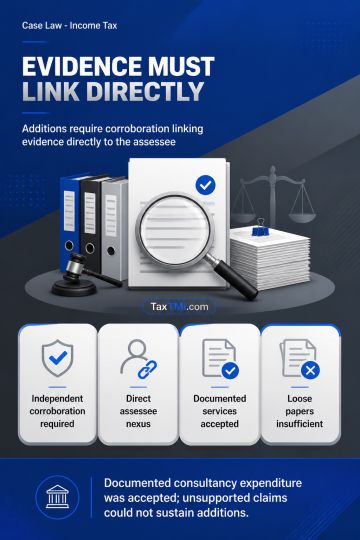
Pharmaceutical promotion and transfer-pricing comparability principles limited disallowances, while uncorroborated search allegations and unsupported ...
Business expenditure substantiation supports scrap credits, statutory payments and expense claims, while depreciation requires proof of actual busines...
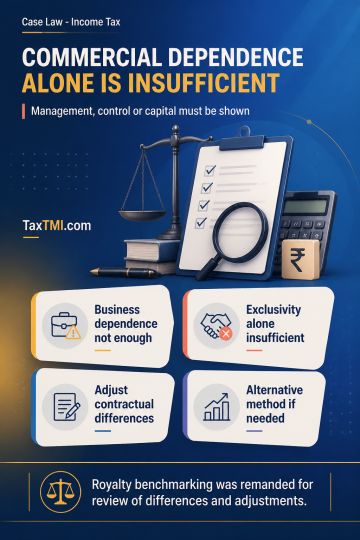
Sections 92A(1) and 92A(2) require a harmonious reading: the statutory circumstances in section 92A(2), including business dependence under section 92A(2)(g), do not independently establish an associated-enterprise relationship without participation in management, control or capital under section 92A(1). Commercial dependence or distribution exclusivity alone is insufficient absent evidence of ownership, voting rights, managerial participation or financial control. For internal CUP analysis, contractual differences do not disqualify an uncontrolled transaction unless they materially affect the royalty rate and cannot be eliminated through reasonably accurate, objectively verifiable adjustments. Royalty benchmarking was remanded to examine those differences and adjustments; if CUP is unreliable, the most appropriate method must be independently selected.
Sections 92A(1) and 92A(2) require a harmonious reading: the statutory circumstances in section 92A(2), including business dependence under section 92A(2)(g), do not independently establish an associated-enterprise relationship without participation in management, control or capital under section 92A(1). Commercial dependence or distribution exclusivity alone is insufficient absent evidence of ownership, voting rights, managerial participation or financial control. For internal CUP analysis, contractual differences do not disqualify an uncontrolled transaction unless they materially affect the royalty rate and cannot be eliminated through reasonably accurate, objectively verifiable adjustments. Royalty benchmarking was remanded to examine those differences and adjustments; if CUP is unreliable, the most appropriate method must be independently selected.
Note: It is a system-generated summary and is for quick reference only.
 TaxTMI
  TaxTMI
 of 4817














 Join Channel