Necessary-party requirements limit impleadment of independent entities, while deferred consideration does not create an appealable adverse determinati...
Food supplement classification requires common parlance and authoritative tests, preventing treatment as proprietary Ayurvedic medicines without suppo...
Specified regulatory authority income receives conditional tax exemption, subject to non-commercial activity, unchanged income character, and return f...
Tax exemption for regulatory authority income applies retrospectively, subject to non-commercial activity, unchanged income sources, and return-filing...
Input tax credit conditions remain constitutionally valid, with eligible recipient claims considered under GST circulars and retrospective filing dead...
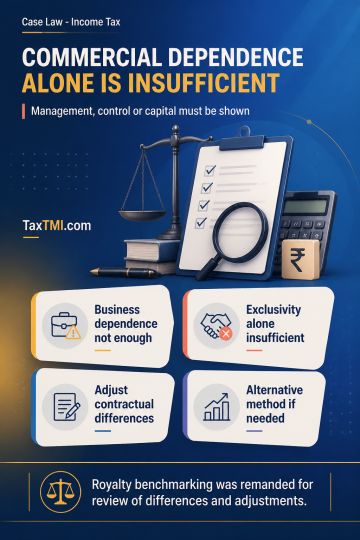
Sections 92A(1) and 92A(2) require a harmonious reading: the statutory circumstances in section 92A(2), including business dependence under section 92A(2)(g), do not independently establish an associated-enterprise relationship without participation in management, control or capital under section 92A(1). Commercial dependence or distribution exclusivity alone is insufficient absent evidence of ownership, voting rights, managerial participation or financial control. For internal CUP analysis, contractual differences do not disqualify an uncontrolled transaction unless they materially affect the royalty rate and cannot be eliminated through reasonably accurate, objectively verifiable adjustments. Royalty benchmarking was remanded to examine those differences and adjustments; if CUP is unreliable, the most appropriate method must be independently selected.
Sections 92A(1) and 92A(2) require a harmonious reading: the statutory circumstances in section 92A(2), including business dependence under section 92A(2)(g), do not independently establish an associated-enterprise relationship without participation in management, control or capital under section 92A(1). Commercial dependence or distribution exclusivity alone is insufficient absent evidence of ownership, voting rights, managerial participation or financial control. For internal CUP analysis, contractual differences do not disqualify an uncontrolled transaction unless they materially affect the royalty rate and cannot be eliminated through reasonably accurate, objectively verifiable adjustments. Royalty benchmarking was remanded to examine those differences and adjustments; if CUP is unreliable, the most appropriate method must be independently selected.
Note: It is a system-generated summary and is for quick reference only.
 TaxTMI
  TaxTMI
 of 4817




















 Join Channel