Origin Declaration authentication governs preferential tariff claims under India-UK CETA, requiring a validated reference number before import clearan...
Separate assessment orders for different years remain valid when distinct notices and hearing opportunities prevent prejudice from combined proceeding...
Defined public benefit can retain charitable character; registration renewal requires examining genuine activities and legal compliance, not surplus a...
Capital reduction is distinct from share buy-back, preventing buy-back tax; restructuring interest and related business deductions also survive scruti...
State-law registration required for educational approval under...
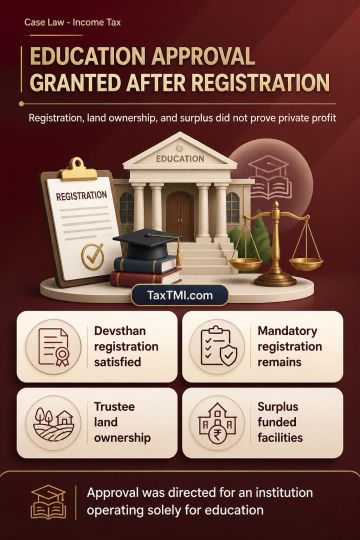
Educational approval requires mandatory State registration, but incidental surplus and trustee-owned land do not prove private benefit or profit motive.
Contents
Summary
Note
Bookmark
Share
✓ Copied successfully !
Print
Print Options
For full text, please login
Login to TaxTMI
Verification Pending
The Email Id has not been verified. Click on the link we have sent on
State-law registration required for educational approval under section 10(23C)(vi) was satisfied once registration with the competent Devsthan authority had been obtained, so absence of registration could not support rejection. Compliance with mandatory State or local registration requirements remains necessary. Trustee ownership of land used for educational infrastructure, without evidence of siphoning, private appropriation, diversion of funds or pecuniary advantage, does not establish private benefit. Incidental surplus from educational activities also does not demonstrate a profit motive where retained and applied to educational infrastructure and facilities. Approval was directed because the institution operated solely for education and not for profit.
State-law registration required for educational approval under section 10(23C)(vi) was satisfied once registration with the competent Devsthan authority had been obtained, so absence of registration could not support rejection. Compliance with mandatory State or local registration requirements remains necessary. Trustee ownership of land used for educational infrastructure, without evidence of siphoning, private appropriation, diversion of funds or pecuniary advantage, does not establish private benefit. Incidental surplus from educational activities also does not demonstrate a profit motive where retained and applied to educational infrastructure and facilities. Approval was directed because the institution operated solely for education and not for profit.
Note: It is a system-generated summary and is for quick reference only.
 TaxTMI
  TaxTMI
 of 4821






















 Join Channel