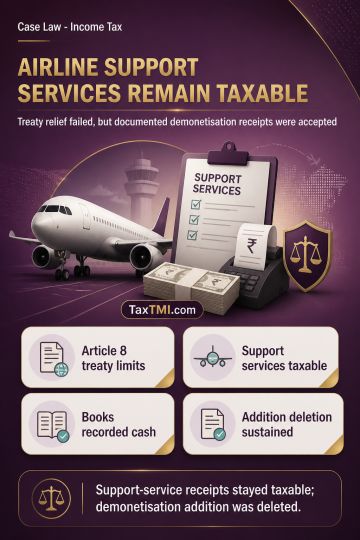
Article 8 treaty coverage excluded third-party airline support services, while documented demonetisation cash receipts remained accepted business inco...
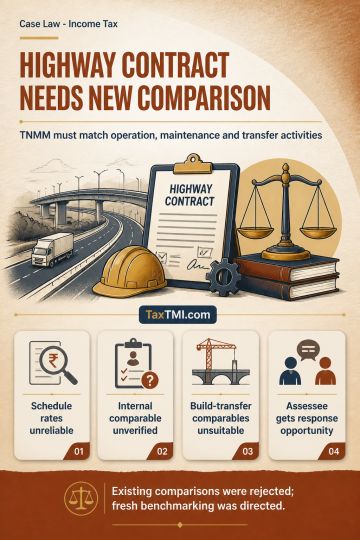
Functional comparability under TNMM requires highway contract benchmarks to reflect operation, maintenance and transfer activities, requiring fresh be...
Objective characteristics govern magnesium bis-glycinate chelate classification as an amino-acid coordination compound, not a food preparation or anti...
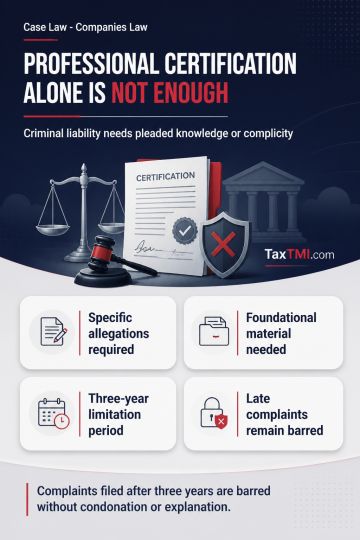
Independent professional certification requires pleaded knowledge or complicity for criminal liability; untimely complaints remain barred by limitatio...
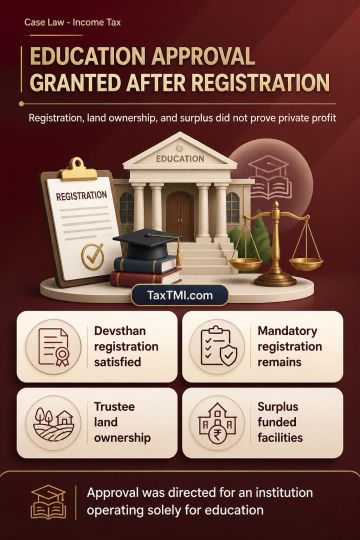
State-law registration required for educational approval under...
Educational approval requires mandatory State registration, but incidental surplus and trustee-owned land do not prove private benefit or profit motive.
Contents
Summary
Note
Bookmark
Share
✓ Copied successfully !
Print
Print Options
For full text, please login
Login to TaxTMI
Verification Pending
The Email Id has not been verified. Click on the link we have sent on
State-law registration required for educational approval under section 10(23C)(vi) was satisfied once registration with the competent Devsthan authority had been obtained, so absence of registration could not support rejection. Compliance with mandatory State or local registration requirements remains necessary. Trustee ownership of land used for educational infrastructure, without evidence of siphoning, private appropriation, diversion of funds or pecuniary advantage, does not establish private benefit. Incidental surplus from educational activities also does not demonstrate a profit motive where retained and applied to educational infrastructure and facilities. Approval was directed because the institution operated solely for education and not for profit.
State-law registration required for educational approval under section 10(23C)(vi) was satisfied once registration with the competent Devsthan authority had been obtained, so absence of registration could not support rejection. Compliance with mandatory State or local registration requirements remains necessary. Trustee ownership of land used for educational infrastructure, without evidence of siphoning, private appropriation, diversion of funds or pecuniary advantage, does not establish private benefit. Incidental surplus from educational activities also does not demonstrate a profit motive where retained and applied to educational infrastructure and facilities. Approval was directed because the institution operated solely for education and not for profit.
Note: It is a system-generated summary and is for quick reference only.
 TaxTMI
  TaxTMI
 of 4814





 Join Channel