Commercial vehicle depreciation, scientifically determined warranty provisions and exempt-income disallowances were resolved in favour of the taxpayer...
Inherited property sale proceeds require capital-gains treatment where ownership is supported by evidence, not suspicion or unverified signature doubt...
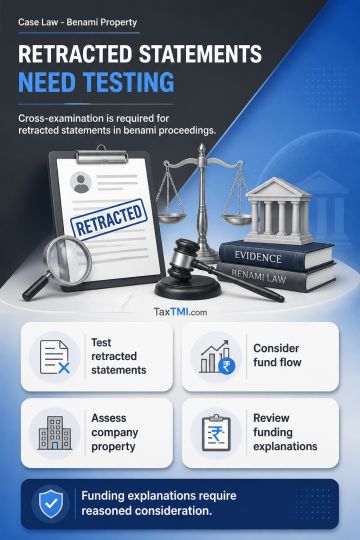
Cross-examination of retracted statements is essential where foundational evidence supports a benami allegation and documented funding explanations re...
Capital-goods exemption covers plant-modernisation accessories, while the import restriction applies only to earlier capital-goods components and spar...
International transhipment of FCL and LCL cargo is permitted...
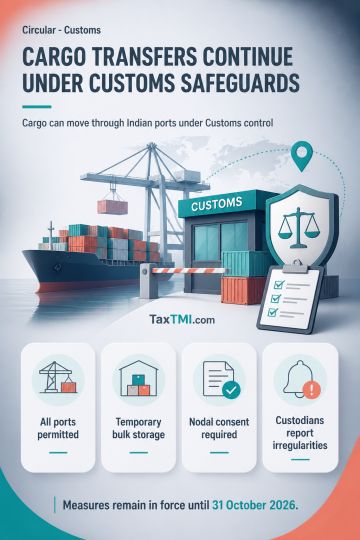
International cargo transhipment through Indian ports continues with Customs-controlled storage, re-export safeguards, and coordinated multi-station movement procedures.
Contents
Summary
Note
Bookmark
Share
✓ Copied successfully !
Print
Print Options
For full text, please login
Login to TaxTMI
Verification Pending
The Email Id has not been verified. Click on the link we have sent on
International transhipment of FCL and LCL cargo is permitted from all seaports and international airports, including movement through other Customs stations, subject to the Customs Act and applicable rules. Liquid bulk, break bulk and solid/dry bulk cargo diverted to Indian ports may be temporarily unloaded, stored and transhipped or re-exported with case-specific permission, Customs supervision, secure custody, inventory controls, testing and safeguards against home consumption or diversion. Multi-station transhipment requires prior nodal-officer consent and controlled movement. Custodians remain responsible for cargo security, handling, accounting and reporting irregularities. These measures operate until 31 October 2026.
International transhipment of FCL and LCL cargo is permitted from all seaports and international airports, including movement through other Customs stations, subject to the Customs Act and applicable rules. Liquid bulk, break bulk and solid/dry bulk cargo diverted to Indian ports may be temporarily unloaded, stored and transhipped or re-exported with case-specific permission, Customs supervision, secure custody, inventory controls, testing and safeguards against home consumption or diversion. Multi-station transhipment requires prior nodal-officer consent and controlled movement. Custodians remain responsible for cargo security, handling, accounting and reporting irregularities. These measures operate until 31 October 2026.
Note: It is a system-generated summary and is for quick reference only.
 TaxTMI
 of 4807













 Join Channel


 TaxTMI