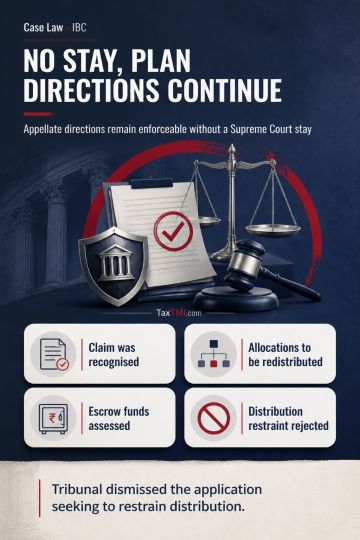
Enforcement of resolution-plan directions continues without a Supreme Court stay, preventing suspension of redistribution and escrowed-fund distributi...
Third-party ownership claims over attached property require Special Court adjudication where purchasers lack registered sale deeds and bona fides rema...
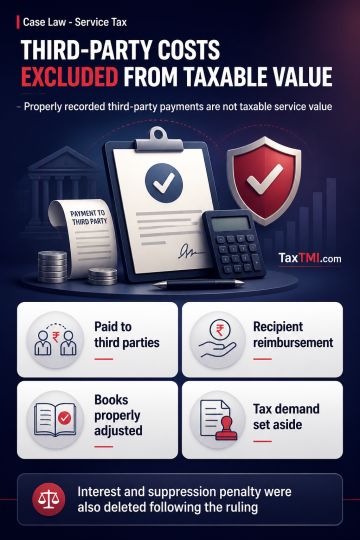
Pure-agent reimbursements in clearing and forwarding services are excluded from taxable value when qualifying third-party payments are properly record...
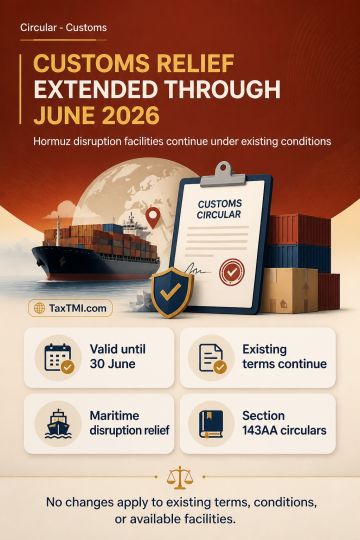
Customs relief for Strait of Hormuz maritime disruptions remains available, with existing conditions continuing unchanged through the extended validit...
International transhipment of FCL and LCL cargo is permitted...
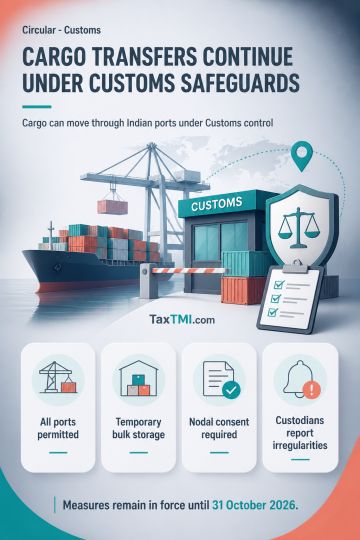
International cargo transhipment through Indian ports continues with Customs-controlled storage, re-export safeguards, and coordinated multi-station movement procedures.
Contents
Summary
Note
Bookmark
Share
✓ Copied successfully !
Print
Print Options
For full text, please login
Login to TaxTMI
Verification Pending
The Email Id has not been verified. Click on the link we have sent on
International transhipment of FCL and LCL cargo is permitted from all seaports and international airports, including movement through other Customs stations, subject to the Customs Act and applicable rules. Liquid bulk, break bulk and solid/dry bulk cargo diverted to Indian ports may be temporarily unloaded, stored and transhipped or re-exported with case-specific permission, Customs supervision, secure custody, inventory controls, testing and safeguards against home consumption or diversion. Multi-station transhipment requires prior nodal-officer consent and controlled movement. Custodians remain responsible for cargo security, handling, accounting and reporting irregularities. These measures operate until 31 October 2026.
International transhipment of FCL and LCL cargo is permitted from all seaports and international airports, including movement through other Customs stations, subject to the Customs Act and applicable rules. Liquid bulk, break bulk and solid/dry bulk cargo diverted to Indian ports may be temporarily unloaded, stored and transhipped or re-exported with case-specific permission, Customs supervision, secure custody, inventory controls, testing and safeguards against home consumption or diversion. Multi-station transhipment requires prior nodal-officer consent and controlled movement. Custodians remain responsible for cargo security, handling, accounting and reporting irregularities. These measures operate until 31 October 2026.
Note: It is a system-generated summary and is for quick reference only.
 TaxTMI
 of 4805






 Join Channel


 TaxTMI