Development agreements require legal possession or effective enjoyment for capital gains transfer; permissive possession and deferred consideration de...
Prolonged sterilisation of development rights supports capital-gains treatment, while business-income disallowances cannot govern capital-gains comput...
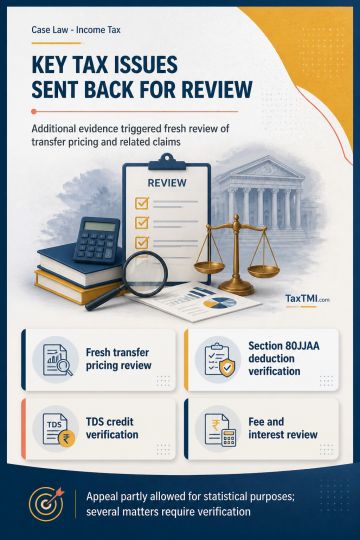
Additional evidence in transfer pricing dispute leads to fresh examination, while tax deductions, TDS credit, fee and refund interest require verifica...
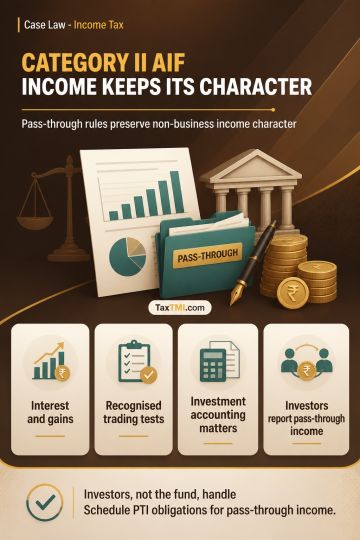
Category II AIF pass-through taxation preserves non-business income character; investment receipts cannot be reclassified without applying recognised ...
Page of 4814
Press 'Enter' after typing page number.
1461 to 1480 of 96262 Results
❮
❯
❯❯
0 / 200
Expand Note
Add to Folder
No Folders have been created
+
Are you sure you want to delete "My most important" ?
Tax-audit obligations do not arise where turnover remains below...
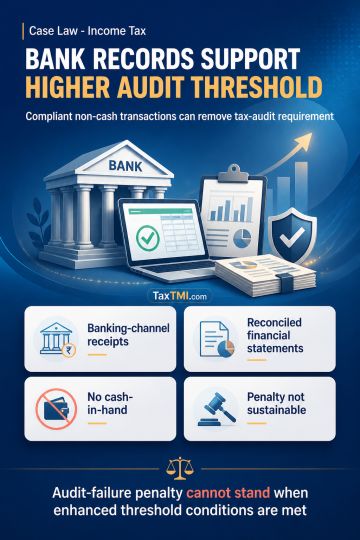
Enhanced tax-audit threshold applies where banking records establish compliant non-cash receipts and payments, eliminating penalty exposure for audit failure.
Contents
Summary
Note
Bookmark
Share
✓ Copied successfully !
Print
Print Options
For full text, please login
Login to TaxTMI
Verification Pending
The Email Id has not been verified. Click on the link we have sent on
Tax-audit obligations do not arise where turnover remains below the enhanced threshold available to taxpayers whose cash receipts and cash payments stay within prescribed limits. Financial statements, bank statements and reconciliation may establish that operational revenue was received through banking channels; differences between bank credits and reported revenue may be attributable to GST and tax deducted at source. Absence of opening or closing cash-in-hand, supported by these records and the tax audit report, can demonstrate that no disqualifying cash transactions occurred. Consequently, penalty for failure to obtain a tax audit is not sustainable where the enhanced threshold applies.
Tax-audit obligations do not arise where turnover remains below the enhanced threshold available to taxpayers whose cash receipts and cash payments stay within prescribed limits. Financial statements, bank statements and reconciliation may establish that operational revenue was received through banking channels; differences between bank credits and reported revenue may be attributable to GST and tax deducted at source. Absence of opening or closing cash-in-hand, supported by these records and the tax audit report, can demonstrate that no disqualifying cash transactions occurred. Consequently, penalty for failure to obtain a tax audit is not sustainable where the enhanced threshold applies.
Note: It is a system-generated summary and is for quick reference only.
 TaxTMI
  TaxTMI
 of 4814






 Join Channel