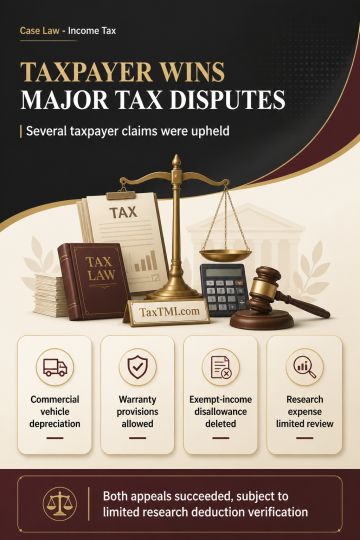
Commercial vehicle depreciation, scientifically determined warranty provisions and exempt-income disallowances were resolved in favour of the taxpayer...
Inherited property sale proceeds require capital-gains treatment where ownership is supported by evidence, not suspicion or unverified signature doubt...
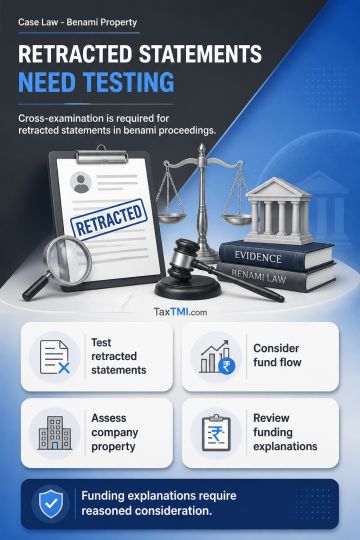
Cross-examination of retracted statements is essential where foundational evidence supports a benami allegation and documented funding explanations re...
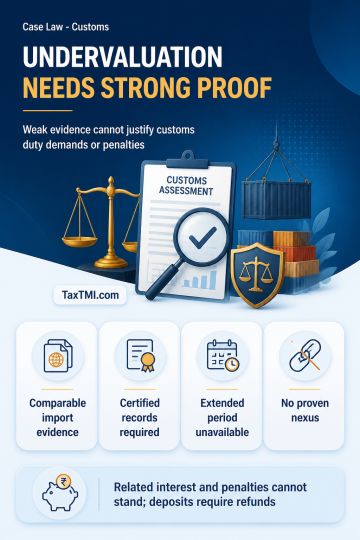
Capital-goods exemption covers plant-modernisation accessories, while the import restriction applies only to earlier capital-goods components and spar...
Tax-audit obligations do not arise where turnover remains below...
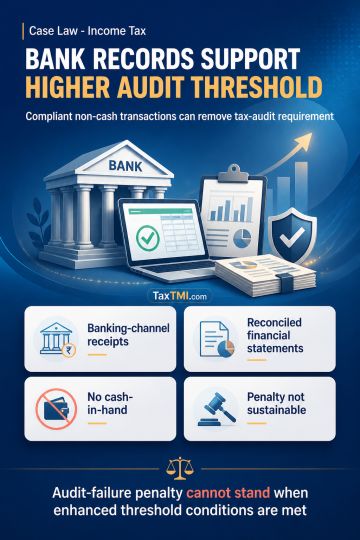
Enhanced tax-audit threshold applies where banking records establish compliant non-cash receipts and payments, eliminating penalty exposure for audit failure.
Contents
Summary
Note
Bookmark
Share
✓ Copied successfully !
Print
Print Options
For full text, please login
Login to TaxTMI
Verification Pending
The Email Id has not been verified. Click on the link we have sent on
Tax-audit obligations do not arise where turnover remains below the enhanced threshold available to taxpayers whose cash receipts and cash payments stay within prescribed limits. Financial statements, bank statements and reconciliation may establish that operational revenue was received through banking channels; differences between bank credits and reported revenue may be attributable to GST and tax deducted at source. Absence of opening or closing cash-in-hand, supported by these records and the tax audit report, can demonstrate that no disqualifying cash transactions occurred. Consequently, penalty for failure to obtain a tax audit is not sustainable where the enhanced threshold applies.
Tax-audit obligations do not arise where turnover remains below the enhanced threshold available to taxpayers whose cash receipts and cash payments stay within prescribed limits. Financial statements, bank statements and reconciliation may establish that operational revenue was received through banking channels; differences between bank credits and reported revenue may be attributable to GST and tax deducted at source. Absence of opening or closing cash-in-hand, supported by these records and the tax audit report, can demonstrate that no disqualifying cash transactions occurred. Consequently, penalty for failure to obtain a tax audit is not sustainable where the enhanced threshold applies.
Note: It is a system-generated summary and is for quick reference only.
 TaxTMI
 of 4805









 Join Channel


 TaxTMI