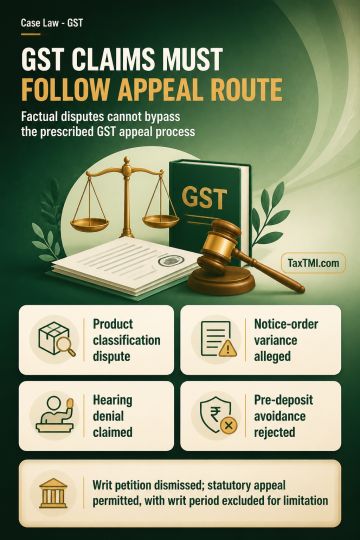
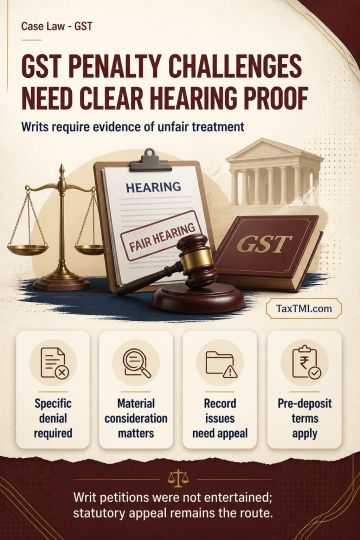
Alternative statutory remedy under GST bars writ challenge where classification, notice variance, and hearing disputes require factual appellate revie...
Duplicate PAN cancellation timeframe requires prior administrative representation before judicial intervention, ensuring a time-bound decision on the ...
Natural justice and pre-CIRP labour awards protect termination compensation, permitting withdrawal of court deposits despite later insolvency resoluti...
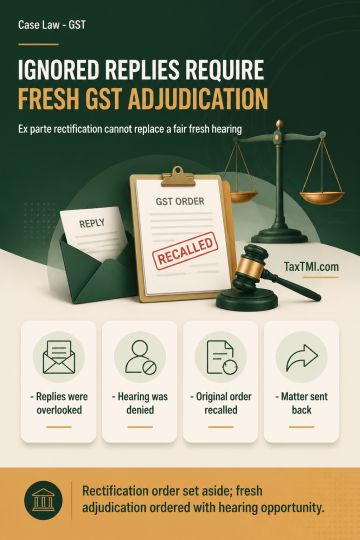
Rectification of an ex parte GST adjudication order cannot become a merits review through another ex parte order. Where the authority omitted to consider the assessee's replies, the defect went to the root of adjudication and required recall of the original order followed by a fresh personal hearing. Although the authority could correct an apparent error on its own motion and exercise inherent procedural-review power to cure denial of hearing, it could not sustain a revised demand without considering the replies and hearing the assessee. The subsequent ex parte rectification order was set aside and the matter remitted for fresh adjudication after granting an opportunity of hearing.
Rectification of an ex parte GST adjudication order cannot become a merits review through another ex parte order. Where the authority omitted to consider the assessee's replies, the defect went to the root of adjudication and required recall of the original order followed by a fresh personal hearing. Although the authority could correct an apparent error on its own motion and exercise inherent procedural-review power to cure denial of hearing, it could not sustain a revised demand without considering the replies and hearing the assessee. The subsequent ex parte rectification order was set aside and the matter remitted for fresh adjudication after granting an opportunity of hearing.
Note: It is a system-generated summary and is for quick reference only.
 TaxTMI
  TaxTMI
 of 4897