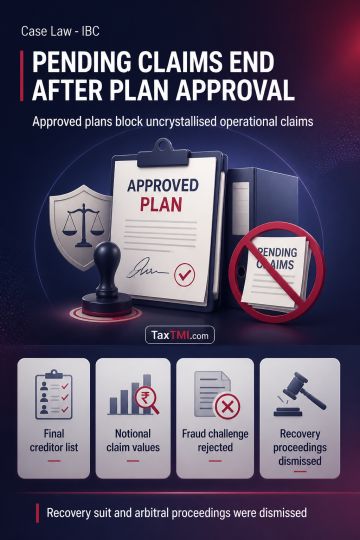
Clean slate principle extinguishes uncrystallised operational claims and bars continuation of pending recovery and arbitral proceedings after plan app...
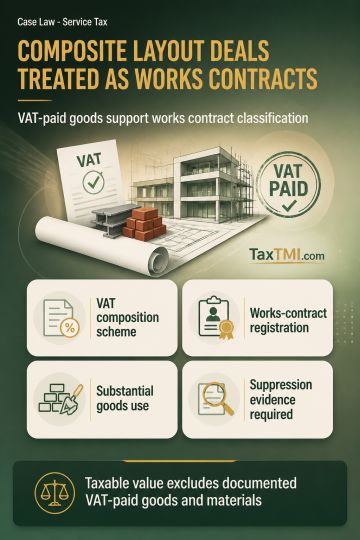
Works contract classification governs composite layout-development contracts where VAT-paid goods are transferred alongside construction and infrastru...
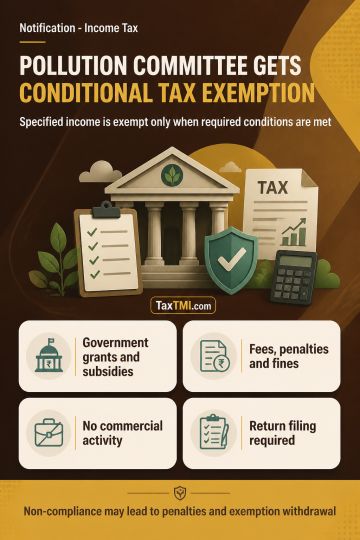
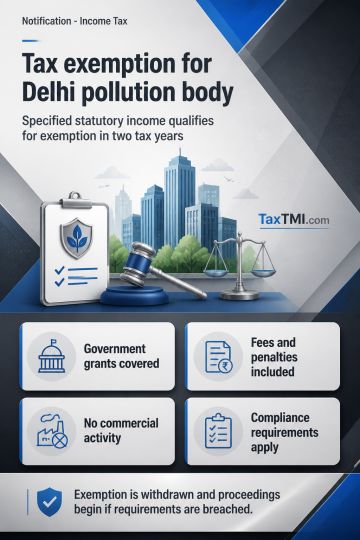
Specified income tax exemption for pollution control body remains conditional on non-commercial activity, unchanged income character, and return filin...
Jurisdictional facts in certificate-of-origin discrepancies can support customs show-cause proceedings, leaving factual explanations for departmental ...
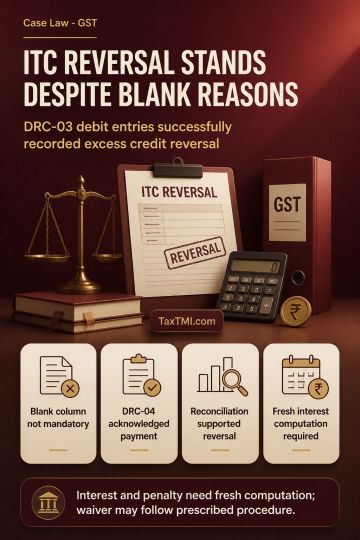
Excess input tax credit relating to invoices for FY 2018-19 to 2020-21 was treated as validly reversed through debit entries in the electronic cash and credit ledgers reported in Form GST DRC-03. Absence of reasons in column 8 did not invalidate the reversal, as that field was not mandatory; Form GST DRC-04 acknowledged payment and the reconciliation statement supported full reversal. Section 16(5) extended the relevant ITC entitlement. For a Section 73 demand within Section 128A, interest and penalty require fresh computation after hearing, with waiver available subject to the prescribed procedure.
Excess input tax credit relating to invoices for FY 2018-19 to 2020-21 was treated as validly reversed through debit entries in the electronic cash and credit ledgers reported in Form GST DRC-03. Absence of reasons in column 8 did not invalidate the reversal, as that field was not mandatory; Form GST DRC-04 acknowledged payment and the reconciliation statement supported full reversal. Section 16(5) extended the relevant ITC entitlement. For a Section 73 demand within Section 128A, interest and penalty require fresh computation after hearing, with waiver available subject to the prescribed procedure.
Note: It is a system-generated summary and is for quick reference only.
 TaxTMI
  TaxTMI
 of 4809








 Join Channel