Additional evidence in transfer pricing dispute leads to fresh examination, while tax deductions, TDS credit, fee and refund interest require verifica...
Category II AIF pass-through taxation preserves non-business income character; investment receipts cannot be reclassified without applying recognised ...
Mutual fund maturity rules require proper rollover, redemption, disclosure, and due diligence; investor gains cannot excuse regulatory breaches or pen...
Threshold exemption excludes exempt services, while stamp-paper purchases avoid reverse charge; consequential service tax penalties were also set asid...
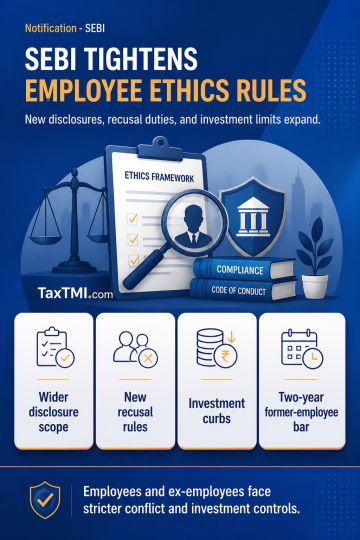
Employee conflict disclosures and investment restrictions expand with new recusal duties, post-employment limits, and compliance reporting requirement...
Overseas university admission-facilitation services supplied to...
Intermediary service classification fails where overseas admission facilitation is supplied independently, preserving export treatment and small-provider exemption.
Contents
Summary
Note
Bookmark
Share
✓ Copied successfully !
Print
Print Options
For full text, please login
Login to TaxTMI
Verification Pending
The Email Id has not been verified. Click on the link we have sent on
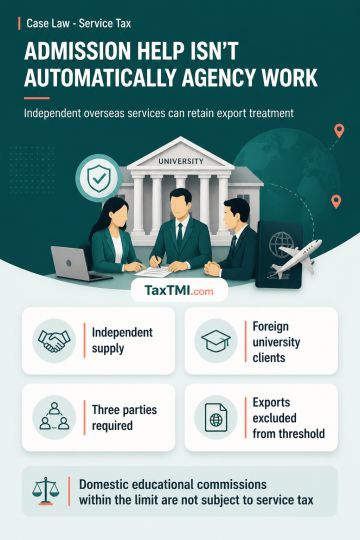
Overseas university admission-facilitation services supplied to foreign universities do not constitute intermediary services merely because the provider is described as an agent and receives commission. Intermediary status requires three parties and two distinct supplies: a main supply and a separate ancillary facilitation supply. Where the provider supplies the principal service on its own account, without a tripartite arrangement or multiple supplies, the service qualifies as export of services. For the small service provider exemption, exported-service value is excluded from the aggregate-value threshold; consequently, commission from domestic educational institutions within the prescribed limit is not subject to service tax.
Overseas university admission-facilitation services supplied to foreign universities do not constitute intermediary services merely because the provider is described as an agent and receives commission. Intermediary status requires three parties and two distinct supplies: a main supply and a separate ancillary facilitation supply. Where the provider supplies the principal service on its own account, without a tripartite arrangement or multiple supplies, the service qualifies as export of services. For the small service provider exemption, exported-service value is excluded from the aggregate-value threshold; consequently, commission from domestic educational institutions within the prescribed limit is not subject to service tax.
Note: It is a system-generated summary and is for quick reference only.
 TaxTMI
  TaxTMI
 of 4811


















 Join Channel