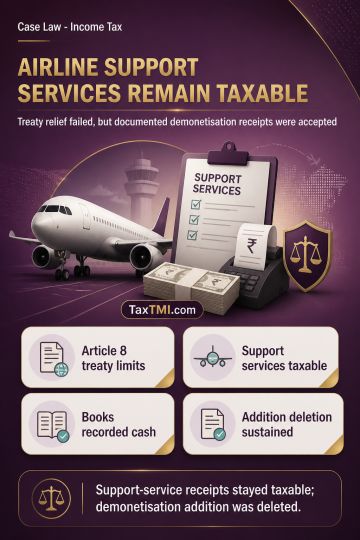
Article 8 treaty coverage excluded third-party airline support services, while documented demonetisation cash receipts remained accepted business inco...
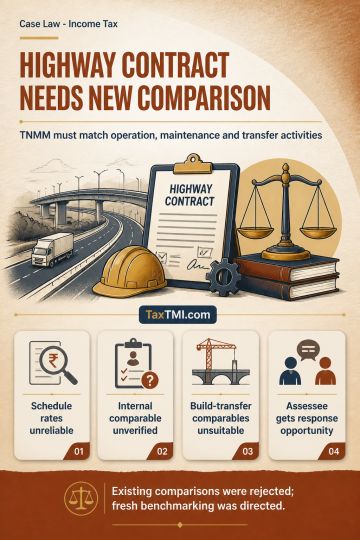
Functional comparability under TNMM requires highway contract benchmarks to reflect operation, maintenance and transfer activities, requiring fresh be...
Objective characteristics govern magnesium bis-glycinate chelate classification as an amino-acid coordination compound, not a food preparation or anti...
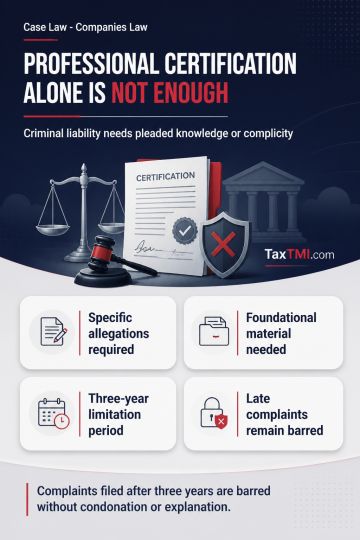
Independent professional certification requires pleaded knowledge or complicity for criminal liability; untimely complaints remain barred by limitatio...
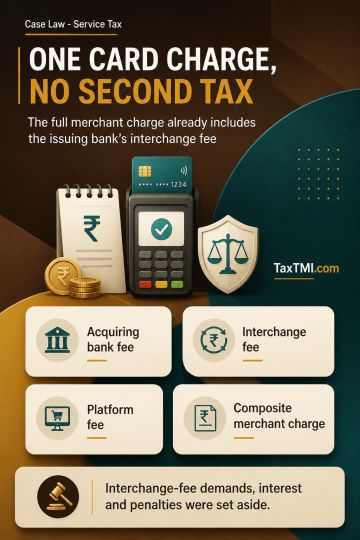
Merchant discount rate in credit-card transactions is a composite charge comprising the acquiring bank fee, issuing bank interchange fee and platform fee. Where service tax has been paid on the entire merchant discount rate, subsequent allocation of the interchange fee to the issuing bank does not create a separately taxable service. A further levy on that retained interchange fee would amount to double taxation, particularly where there is no revenue loss. Service-tax demands on interchange fee, along with consequential interest and penalties, were therefore unsustainable and set aside.
Merchant discount rate in credit-card transactions is a composite charge comprising the acquiring bank fee, issuing bank interchange fee and platform fee. Where service tax has been paid on the entire merchant discount rate, subsequent allocation of the interchange fee to the issuing bank does not create a separately taxable service. A further levy on that retained interchange fee would amount to double taxation, particularly where there is no revenue loss. Service-tax demands on interchange fee, along with consequential interest and penalties, were therefore unsustainable and set aside.
Note: It is a system-generated summary and is for quick reference only.
 TaxTMI
 of 4805










 Join Channel


 TaxTMI
