Development agreements require legal possession or effective enjoyment for capital gains transfer; permissive possession and deferred consideration de...
Prolonged sterilisation of development rights supports capital-gains treatment, while business-income disallowances cannot govern capital-gains comput...
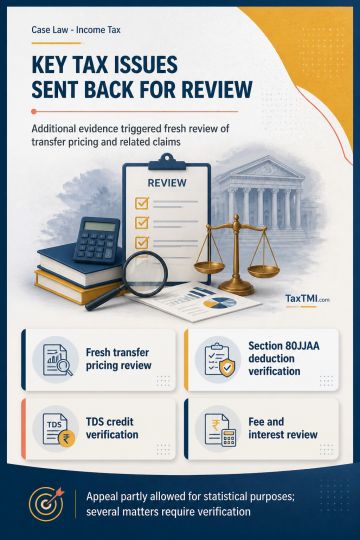
Additional evidence in transfer pricing dispute leads to fresh examination, while tax deductions, TDS credit, fee and refund interest require verifica...
Category II AIF pass-through taxation preserves non-business income character; investment receipts cannot be reclassified without applying recognised ...
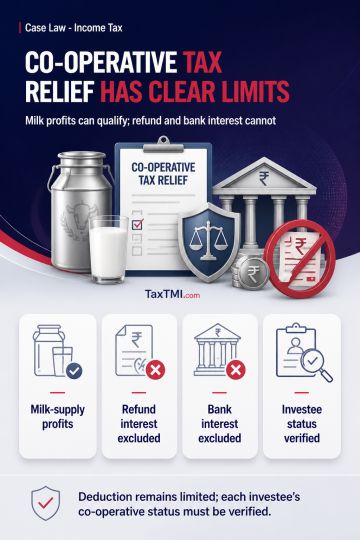
Section 80P deduction for a milk co-operative is confined to...
Co-operative deduction eligibility excludes refund and commercial-bank interest, while qualifying co-operative investments require entity-wise verification.
Contents
Summary
Note
Bookmark
Share
✓ Copied successfully !
Print
Print Options
For full text, please login
Login to TaxTMI
Verification Pending
The Email Id has not been verified. Click on the link we have sent on
Section 80P deduction for a milk co-operative is confined to profits from the specified milk-supply business. Interest on an income-tax refund derives from the statutory compensation for excess tax retention, not that business, and is ineligible. Interest from commercial-bank deposits likewise neither arises from the specified business nor qualifies as investment income from another co-operative society. Interest and dividends from investments with co-operative societies may qualify independently of the primary business, subject to entity-wise verification of each investee's co-operative status. Contributions to an approved gratuity fund remain subject to the ordinary annual contribution limit under Rule 103. Interest for delayed TDS deposit is not business expenditure, and a challenge solely to penalty initiation for under-reporting is premature.
Section 80P deduction for a milk co-operative is confined to profits from the specified milk-supply business. Interest on an income-tax refund derives from the statutory compensation for excess tax retention, not that business, and is ineligible. Interest from commercial-bank deposits likewise neither arises from the specified business nor qualifies as investment income from another co-operative society. Interest and dividends from investments with co-operative societies may qualify independently of the primary business, subject to entity-wise verification of each investee's co-operative status. Contributions to an approved gratuity fund remain subject to the ordinary annual contribution limit under Rule 103. Interest for delayed TDS deposit is not business expenditure, and a challenge solely to penalty initiation for under-reporting is premature.
Note: It is a system-generated summary and is for quick reference only.
 TaxTMI
  TaxTMI
 of 4807












 Join Channel