Defined public benefit can retain charitable character; registration renewal requires examining genuine activities and legal compliance, not surplus a...
Capital reduction is distinct from share buy-back, preventing buy-back tax; restructuring interest and related business deductions also survive scruti...
Transfer pricing and tax deductions upheld on established principles, while employee contributions and warranty provisions returned for fresh examinat...
Captive transfer pricing relies on industrial consumer tariffs, while genuine quotations can benchmark effluent treatment transfers under the Other Me...
Specific tariff classification for ophthalmic instruments and extended limitation principles determine the treatment of duty demands, confiscation, an...
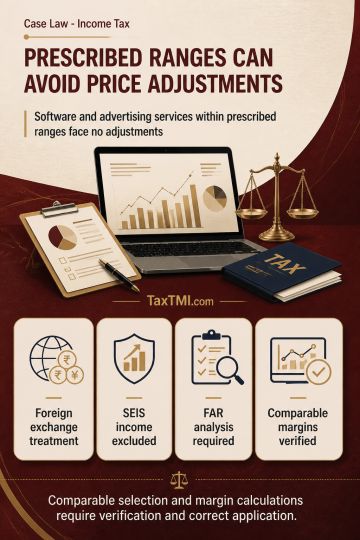
Transfer pricing tolerance rules govern software development and online advertisement support services where the tested party's margins or transaction prices fall within the prescribed range. Foreign exchange gains or losses linked to export invoices may be operating items for IT-enabled services, subject to verification and corresponding treatment in comparable-company margins. Income from sale of SEIS scrips is non-operating because it arises from an incentive scheme rather than service exports, requiring parity adjustments for comparables. Comparable selection requires final search criteria and detailed FAR analysis: companies with negligible IT-enabled services activity may be excluded, while additional or previously selected comparables may be reconsidered. Comparable-margin computations require verification and correct application.
Transfer pricing tolerance rules govern software development and online advertisement support services where the tested party's margins or transaction prices fall within the prescribed range. Foreign exchange gains or losses linked to export invoices may be operating items for IT-enabled services, subject to verification and corresponding treatment in comparable-company margins. Income from sale of SEIS scrips is non-operating because it arises from an incentive scheme rather than service exports, requiring parity adjustments for comparables. Comparable selection requires final search criteria and detailed FAR analysis: companies with negligible IT-enabled services activity may be excluded, while additional or previously selected comparables may be reconsidered. Comparable-margin computations require verification and correct application.
Note: It is a system-generated summary and is for quick reference only.
 TaxTMI
 of 4807






















 Join Channel


 TaxTMI

