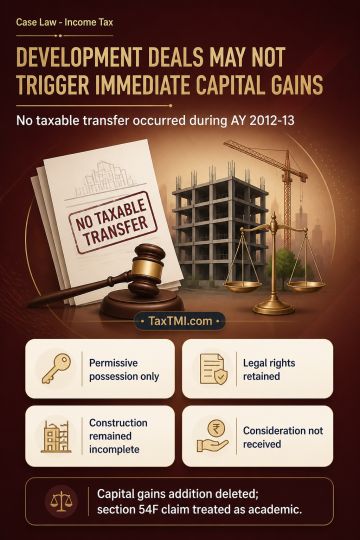
Development agreements require legal possession or effective enjoyment for capital gains transfer; permissive possession and deferred consideration de...
Prolonged sterilisation of development rights supports capital-gains treatment, while business-income disallowances cannot govern capital-gains comput...
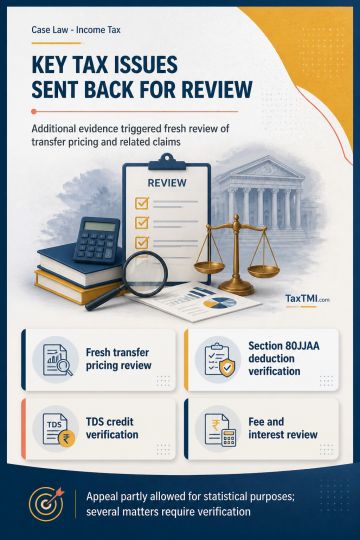
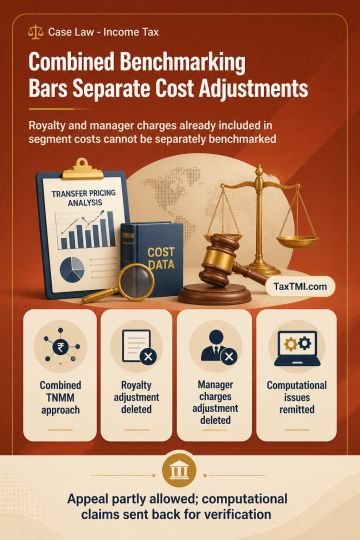
Additional evidence in transfer pricing dispute leads to fresh examination, while tax deductions, TDS credit, fee and refund interest require verifica...
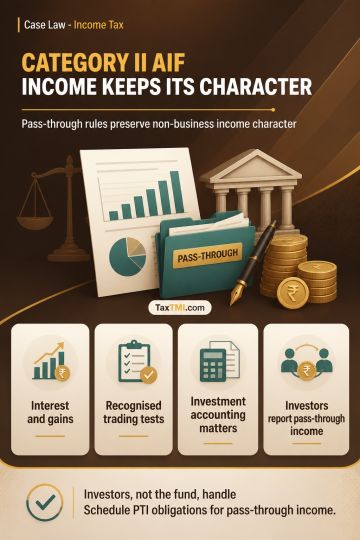
Category II AIF pass-through taxation preserves non-business income character; investment receipts cannot be reclassified without applying recognised ...
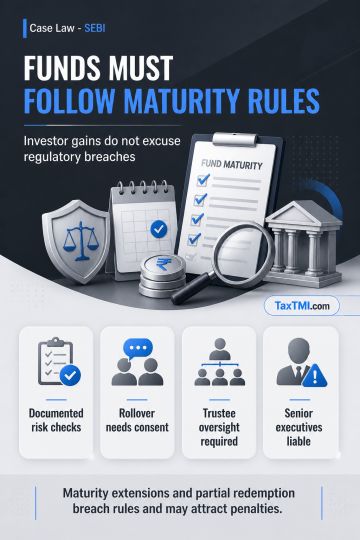
Mutual fund maturity rules require proper rollover, redemption, disclosure, and due diligence; investor gains cannot excuse regulatory breaches or pen...
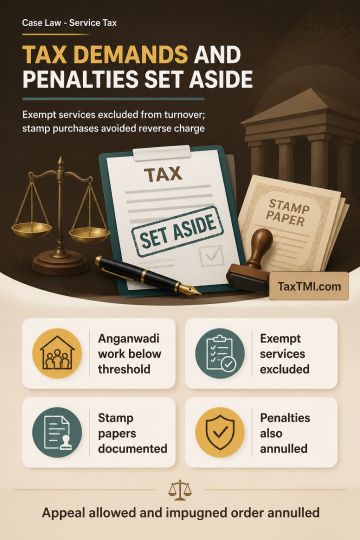
Threshold exemption excludes exempt services, while stamp-paper purchases avoid reverse charge; consequential service tax penalties were also set asid...
Page of 4809
Press 'Enter' after typing page number.
1381 to 1400 of 96174 Results
❮
❯
❯❯
0 / 200
Expand Note
Add to Folder
No Folders have been created
+
Are you sure you want to delete "My most important" ?
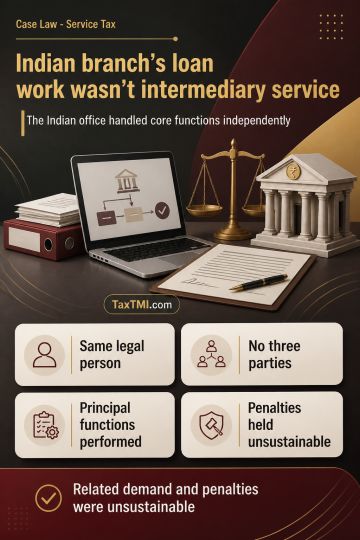
Intermediary service classification does not apply to loan origination, credit assessment, structuring, disbursement and loan-management activities performed by an Indian bank office for its Singapore head office where both form the same legal person. The arrangement lacks the required three distinct parties, identifiable main and ancillary supplies, and remuneration linked to the external lending service. The Indian office performs principal functions on its own account, while the head office alone enters into and makes final decisions on external commercial borrowing arrangements. The activities are therefore not liable to service tax as intermediary services, rendering the related demand and penalties unsustainable.
Intermediary service classification does not apply to loan origination, credit assessment, structuring, disbursement and loan-management activities performed by an Indian bank office for its Singapore head office where both form the same legal person. The arrangement lacks the required three distinct parties, identifiable main and ancillary supplies, and remuneration linked to the external lending service. The Indian office performs principal functions on its own account, while the head office alone enters into and makes final decisions on external commercial borrowing arrangements. The activities are therefore not liable to service tax as intermediary services, rendering the related demand and penalties unsustainable.
Note: It is a system-generated summary and is for quick reference only.
 TaxTMI
  TaxTMI
 of 4809




 Join Channel