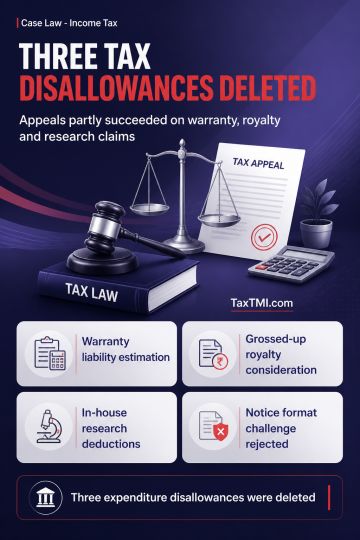
Tax deduction compliance and payee income recognition govern consultancy disallowance, while no exempt income prevents related expenditure disallowanc...
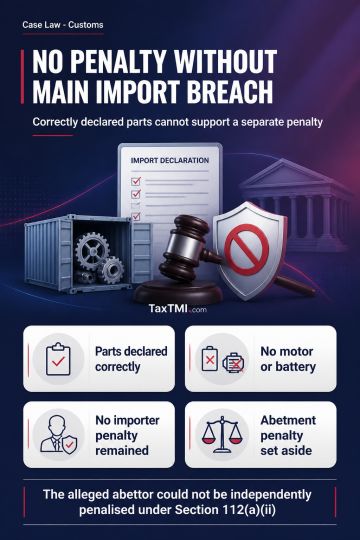
Derivative abetment liability fails when correctly declared imported components establish no underlying improper importation by the principal importer...
Page of 4805
Press 'Enter' after typing page number.
701 to 720 of 96100 Results
❮
❯
❯❯
0 / 200
Expand Note
Add to Folder
No Folders have been created
+
Are you sure you want to delete "My most important" ?
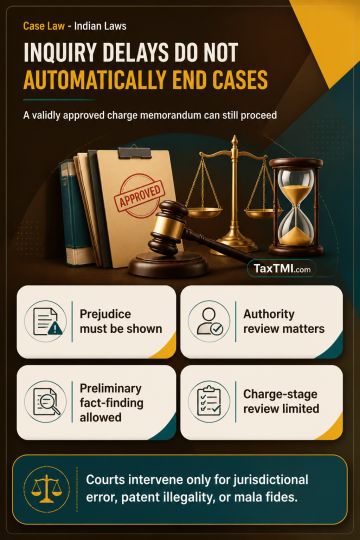
Rule 14(24) of the CCS (CCA) Rules does not automatically invalidate disciplinary proceedings merely because an inquiry exceeds the prescribed period without a written extension. Its time prescription is directory because it specifies no abatement or invalidation consequence; intervention requires inordinate unexplained delay, demonstrable prejudice, mala fides, or oppressive proceedings. Deferred promotion during pending proceedings alone is not legal prejudice. Approval of a charge memorandum is valid where the competent disciplinary authority considered the proposal, vigilance advice and relevant records; unsupported allegations of mechanical approval are insufficient. Preliminary fact-finding during deputation is permissible, and judicial review at the charge stage remains limited to jurisdictional error, patent illegality, mala fides, or fundamental statutory violation.
Rule 14(24) of the CCS (CCA) Rules does not automatically invalidate disciplinary proceedings merely because an inquiry exceeds the prescribed period without a written extension. Its time prescription is directory because it specifies no abatement or invalidation consequence; intervention requires inordinate unexplained delay, demonstrable prejudice, mala fides, or oppressive proceedings. Deferred promotion during pending proceedings alone is not legal prejudice. Approval of a charge memorandum is valid where the competent disciplinary authority considered the proposal, vigilance advice and relevant records; unsupported allegations of mechanical approval are insufficient. Preliminary fact-finding during deputation is permissible, and judicial review at the charge stage remains limited to jurisdictional error, patent illegality, mala fides, or fundamental statutory violation.
Note: It is a system-generated summary and is for quick reference only.
 TaxTMI
 of 4805














 Join Channel


 TaxTMI