Development agreements require legal possession or effective enjoyment for capital gains transfer; permissive possession and deferred consideration de...
Prolonged sterilisation of development rights supports capital-gains treatment, while business-income disallowances cannot govern capital-gains comput...
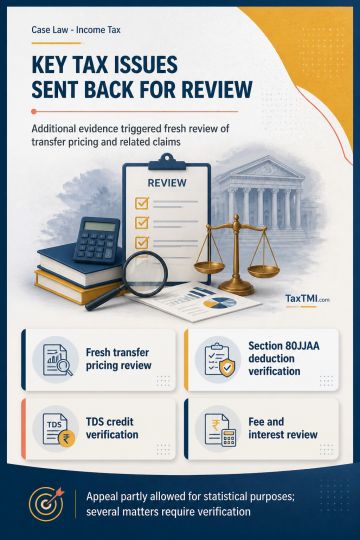
Additional evidence in transfer pricing dispute leads to fresh examination, while tax deductions, TDS credit, fee and refund interest require verifica...
Category II AIF pass-through taxation preserves non-business income character; investment receipts cannot be reclassified without applying recognised ...
Section 129(3) of the CGST/KGST Act requires a proper officer to pass a penalty order within seven days of serving a detention notice for goods in transit. The use of "shall" is treated as mandatory because the provision governs coercive detention and seizure powers, even though no express consequence is specified for delay. A penalty order issued forty-seven days after notice was treated as beyond the prescribed limitation and without jurisdiction. The resulting penalty and appellate orders were set aside, with consequential release of the bank guarantee.
Section 129(3) of the CGST/KGST Act requires a proper officer to pass a penalty order within seven days of serving a detention notice for goods in transit. The use of "shall" is treated as mandatory because the provision governs coercive detention and seizure powers, even though no express consequence is specified for delay. A penalty order issued forty-seven days after notice was treated as beyond the prescribed limitation and without jurisdiction. The resulting penalty and appellate orders were set aside, with consequential release of the bank guarantee.
Note: It is a system-generated summary and is for quick reference only.
 TaxTMI
 of 4805




















 Join Channel



 TaxTMI
