Provisional attachment of laundered funds and equivalent-value property sustained, with statutory protection limited to pension, gratuity and providen...
Insolvency moratorium does not shield company officers from cheque dishonour prosecution for liability arising before corporate insolvency proceedings...
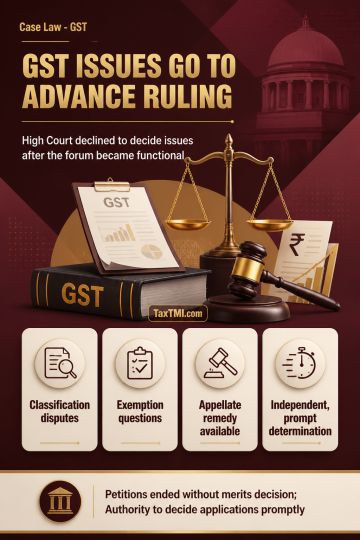
Advance-ruling mechanism governs pending GST classification, exemption and taxability disputes, limiting writ review once the specialised forum functi...
Section 129(3) of the CGST/KGST Act requires a proper officer to pass a penalty order within seven days of serving a detention notice for goods in transit. The use of "shall" is treated as mandatory because the provision governs coercive detention and seizure powers, even though no express consequence is specified for delay. A penalty order issued forty-seven days after notice was treated as beyond the prescribed limitation and without jurisdiction. The resulting penalty and appellate orders were set aside, with consequential release of the bank guarantee.
Section 129(3) of the CGST/KGST Act requires a proper officer to pass a penalty order within seven days of serving a detention notice for goods in transit. The use of "shall" is treated as mandatory because the provision governs coercive detention and seizure powers, even though no express consequence is specified for delay. A penalty order issued forty-seven days after notice was treated as beyond the prescribed limitation and without jurisdiction. The resulting penalty and appellate orders were set aside, with consequential release of the bank guarantee.
Note: It is a system-generated summary and is for quick reference only.
 TaxTMI
 of 4803




















 Join Channel



 TaxTMI
