Defined public benefit can retain charitable character; registration renewal requires examining genuine activities and legal compliance, not surplus a...
Capital reduction is distinct from share buy-back, preventing buy-back tax; restructuring interest and related business deductions also survive scruti...
Transfer pricing and tax deductions upheld on established principles, while employee contributions and warranty provisions returned for fresh examinat...
Captive transfer pricing relies on industrial consumer tariffs, while genuine quotations can benchmark effluent treatment transfers under the Other Me...
Specific tariff classification for ophthalmic instruments and extended limitation principles determine the treatment of duty demands, confiscation, an...
Commission payments to agents were allowable as business...
Commission expenditure linked to pharmaceutical marketing income qualifies as business deduction when recipient identity, genuineness and business purpose are established.
Contents
Summary
Note
Bookmark
Share
✓ Copied successfully !
Print
Print Options
For full text, please login
Login to TaxTMI
Verification Pending
The Email Id has not been verified. Click on the link we have sent on
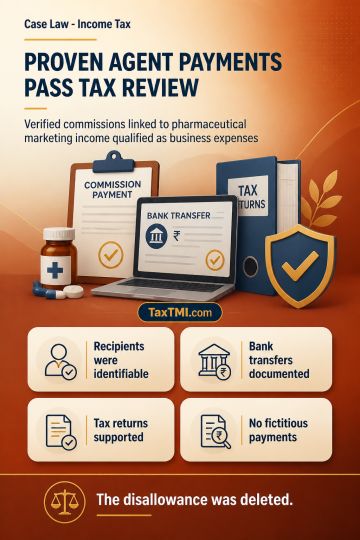
Commission payments to agents were allowable as business expenditure where they were intrinsically linked to commission income earned from pharmaceutical companies for facilitating marketing and sales. The disallowance based on an assumption that payments related to direct sales to Government hospitals lacked factual support. Recipient details, tax deduction at source, banking-channel payments and recipients' income-tax returns established the identity of recipients, genuineness of payments and business purpose. With no evidence of fictitious payments, non-existent recipients or diversion back to the assessee, the expenditure satisfied the wholly and exclusively business-purpose test and the disallowance was deleted.
Commission payments to agents were allowable as business expenditure where they were intrinsically linked to commission income earned from pharmaceutical companies for facilitating marketing and sales. The disallowance based on an assumption that payments related to direct sales to Government hospitals lacked factual support. Recipient details, tax deduction at source, banking-channel payments and recipients' income-tax returns established the identity of recipients, genuineness of payments and business purpose. With no evidence of fictitious payments, non-existent recipients or diversion back to the assessee, the expenditure satisfied the wholly and exclusively business-purpose test and the disallowance was deleted.
Note: It is a system-generated summary and is for quick reference only.
 TaxTMI
 of 4805






















 Join Channel


 TaxTMI

