Clean slate principle extinguishes uncrystallised operational claims and bars continuation of pending recovery and arbitral proceedings after plan app...
Works contract classification governs composite layout-development contracts where VAT-paid goods are transferred alongside construction and infrastru...
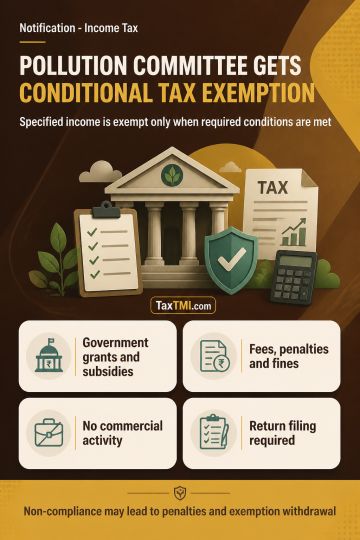
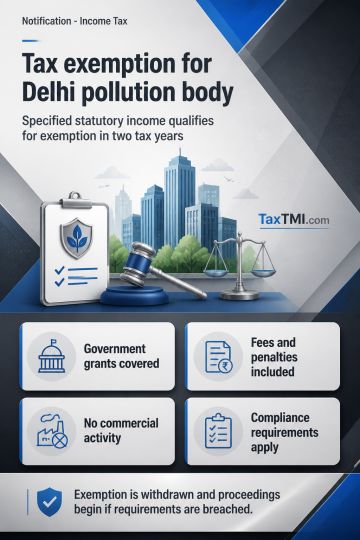
Specified income tax exemption for pollution control body remains conditional on non-commercial activity, unchanged income character, and return filin...
Commission payments to agents were allowable as business...
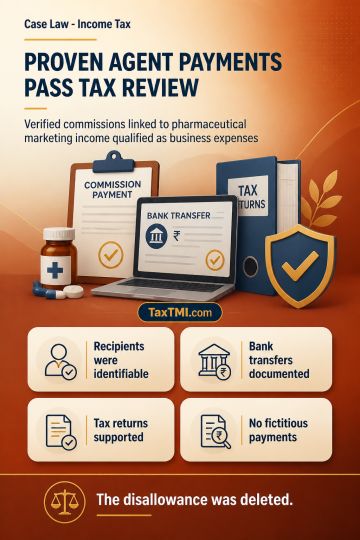
Commission expenditure linked to pharmaceutical marketing income qualifies as business deduction when recipient identity, genuineness and business purpose are established.
Contents
Summary
Note
Bookmark
Share
✓ Copied successfully !
Print
Print Options
For full text, please login
Login to TaxTMI
Verification Pending
The Email Id has not been verified. Click on the link we have sent on
Commission payments to agents were allowable as business expenditure where they were intrinsically linked to commission income earned from pharmaceutical companies for facilitating marketing and sales. The disallowance based on an assumption that payments related to direct sales to Government hospitals lacked factual support. Recipient details, tax deduction at source, banking-channel payments and recipients' income-tax returns established the identity of recipients, genuineness of payments and business purpose. With no evidence of fictitious payments, non-existent recipients or diversion back to the assessee, the expenditure satisfied the wholly and exclusively business-purpose test and the disallowance was deleted.
Commission payments to agents were allowable as business expenditure where they were intrinsically linked to commission income earned from pharmaceutical companies for facilitating marketing and sales. The disallowance based on an assumption that payments related to direct sales to Government hospitals lacked factual support. Recipient details, tax deduction at source, banking-channel payments and recipients' income-tax returns established the identity of recipients, genuineness of payments and business purpose. With no evidence of fictitious payments, non-existent recipients or diversion back to the assessee, the expenditure satisfied the wholly and exclusively business-purpose test and the disallowance was deleted.
Note: It is a system-generated summary and is for quick reference only.
 TaxTMI
 of 4805









 Join Channel


 TaxTMI