Defined public benefit can retain charitable character; registration renewal requires examining genuine activities and legal compliance, not surplus a...
Capital reduction is distinct from share buy-back, preventing buy-back tax; restructuring interest and related business deductions also survive scruti...
Transfer pricing and tax deductions upheld on established principles, while employee contributions and warranty provisions returned for fresh examinat...
Captive transfer pricing relies on industrial consumer tariffs, while genuine quotations can benchmark effluent treatment transfers under the Other Me...
Specific tariff classification for ophthalmic instruments and extended limitation principles determine the treatment of duty demands, confiscation, an...
Integrated golf function determines classification, placing launch monitors and simulators under other golf equipment rather than measuring instrument...
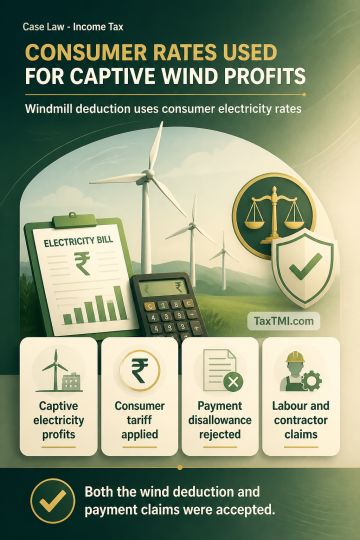
Profits from an eligible windmill unit's electricity transferred for captive consumption qualify for deduction under section 80IA. The profit must be computed using the rate charged by the Electricity Board to consumers, rather than the lower rate paid by the Board to generating companies. Payments were not liable to disallowance merely because payees could not be produced after a substantial lapse of time or because expenditure had increased over earlier years. The nature of payees, including labourers, contractors and job workers, and the fact that several payments were below the tax-deduction threshold, precluded treatment of the payments as unexplained. Deduction for captive wind-generated electricity and the payment claims were consequently accepted.
Profits from an eligible windmill unit's electricity transferred for captive consumption qualify for deduction under section 80IA. The profit must be computed using the rate charged by the Electricity Board to consumers, rather than the lower rate paid by the Board to generating companies. Payments were not liable to disallowance merely because payees could not be produced after a substantial lapse of time or because expenditure had increased over earlier years. The nature of payees, including labourers, contractors and job workers, and the fact that several payments were below the tax-deduction threshold, precluded treatment of the payments as unexplained. Deduction for captive wind-generated electricity and the payment claims were consequently accepted.
Note: It is a system-generated summary and is for quick reference only.
 TaxTMI
 of 4807





















 Join Channel


 TaxTMI
