Business expenditure deduction requires proof of genuine commission payments and commercial allowability; turnover growth alone cannot validate the cl...
Article 8 treaty coverage excluded third-party airline support services, while documented demonetisation cash receipts remained accepted business inco...
Functional comparability under TNMM requires highway contract benchmarks to reflect operation, maintenance and transfer activities, requiring fresh be...
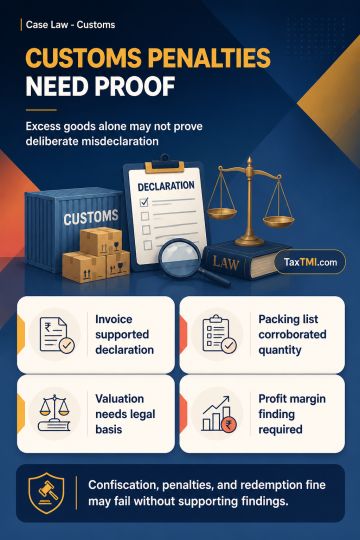
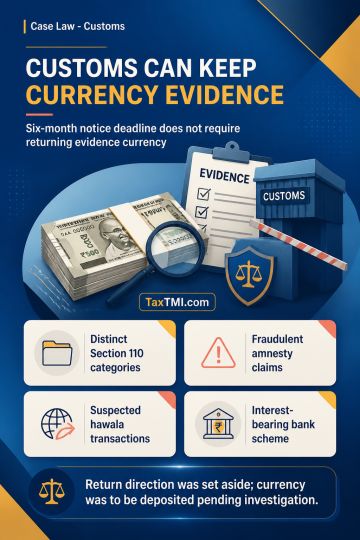
Section 110 distinguishes goods seized for confiscation from documents or things retained as useful or relevant to Customs Act proceedings. The six-month notice period applies to goods seized under Section 110(1), but not to currency treated as a "thing" under Section 110(3) when retained as evidence in an investigation into fraudulent amnesty claims, suspected hawala transactions, illegal gratification, or related offences. Currency is treated as goods where it is itself the subject of a customs violation, such as undeclared cross-border carriage. The return direction was set aside, and the currency was to be deposited in an interest-bearing nationalised-bank scheme pending investigation.
Section 110 distinguishes goods seized for confiscation from documents or things retained as useful or relevant to Customs Act proceedings. The six-month notice period applies to goods seized under Section 110(1), but not to currency treated as a "thing" under Section 110(3) when retained as evidence in an investigation into fraudulent amnesty claims, suspected hawala transactions, illegal gratification, or related offences. Currency is treated as goods where it is itself the subject of a customs violation, such as undeclared cross-border carriage. The return direction was set aside, and the currency was to be deposited in an interest-bearing nationalised-bank scheme pending investigation.
Note: It is a system-generated summary and is for quick reference only.
 TaxTMI
 of 4803













 Join Channel


 TaxTMI