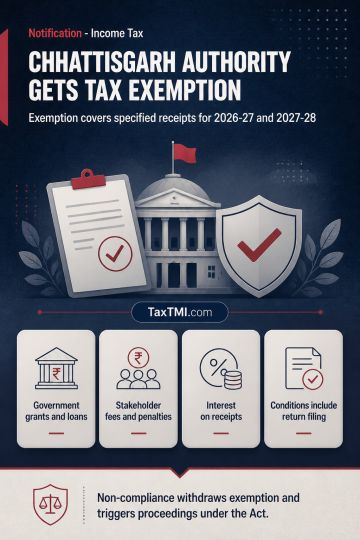
Specified regulatory authority income receives conditional tax exemption, subject to non-commercial activity, unchanged income character, and return f...
Tax exemption for regulatory authority income applies retrospectively, subject to non-commercial activity, unchanged income sources, and return-filing...
Input tax credit conditions remain constitutionally valid, with eligible recipient claims considered under GST circulars and retrospective filing dead...
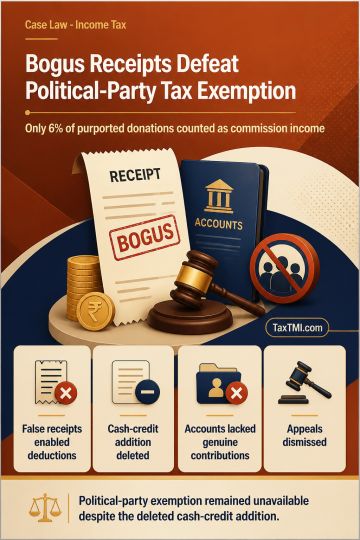
Bogus donation receipts justified commission income assessment and defeated political-party tax exemption for inaccurate accounts and reporting failur...
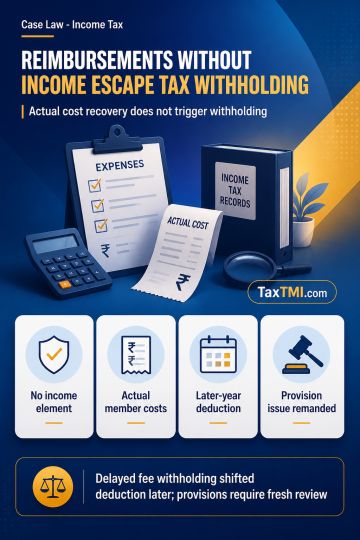
Pure reimbursement without income element escapes tax withholding, while delayed withholding and unsupported provisions face deferred or renewed scrut...
Public benefit requirement defeats charitable registration where residents' association services are reciprocal, member-only facilities governed by mu...
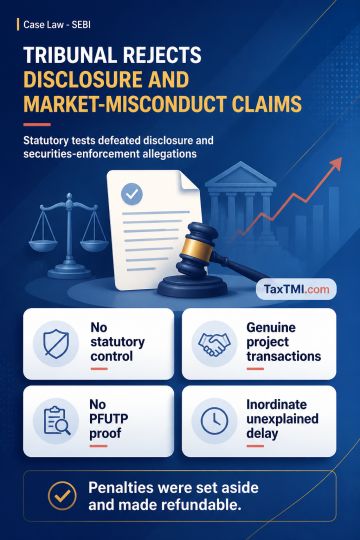
Statutory associate-company criteria governed whether the group company required consolidation and related-party disclosures. The Tribunal majority found no prescribed voting threshold, agreement, control, or participation in business decisions; accounting standards could supplement but not override the statutory definition. Consolidation and related-party disclosure contraventions therefore failed. The majority also found the real-estate bulk-sale memoranda and underlying projects genuine, with no proof that common personnel, funding arrangements, accounting differences, or weak finances established a sham scheme, market impact, unlawful gain, or PFUTP violation. Securities-enforcement proceedings were further initiated after inordinate, unexplained delay following completed transactions. The appeals succeeded, penalties were set aside and refundable; the Presiding Officer dissented.
Statutory associate-company criteria governed whether the group company required consolidation and related-party disclosures. The Tribunal majority found no prescribed voting threshold, agreement, control, or participation in business decisions; accounting standards could supplement but not override the statutory definition. Consolidation and related-party disclosure contraventions therefore failed. The majority also found the real-estate bulk-sale memoranda and underlying projects genuine, with no proof that common personnel, funding arrangements, accounting differences, or weak finances established a sham scheme, market impact, unlawful gain, or PFUTP violation. Securities-enforcement proceedings were further initiated after inordinate, unexplained delay following completed transactions. The appeals succeeded, penalties were set aside and refundable; the Presiding Officer dissented.
Note: It is a system-generated summary and is for quick reference only.
 TaxTMI
 of 4801













 Join Channel


 TaxTMI
