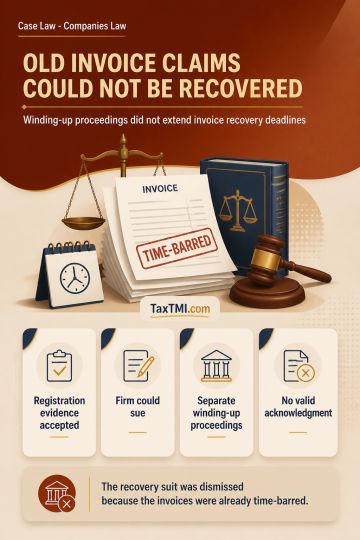
Invoice-based recovery claims remain time-barred despite separate winding-up proceedings, absent valid acknowledgment or part-payment of the disputed ...
Extended limitation fails without specific suppression allegations, while overseas employee secondment remains taxable as manpower supply within norma...
Time-share accommodation classification excludes Club or Association Service where purchasers receive contractual occupancy rights without genuine mem...
CENVAT credit for trading requires reversal, while taxable-service rental credit remains proportionately available and limitation issues await resolut...
Page of 4792
Press 'Enter' after typing page number.
61 to 80 of 95833 Results
❮
❯
❯❯
0 / 200
Expand Note
Add to Folder
No Folders have been created
+
Are you sure you want to delete "My most important" ?
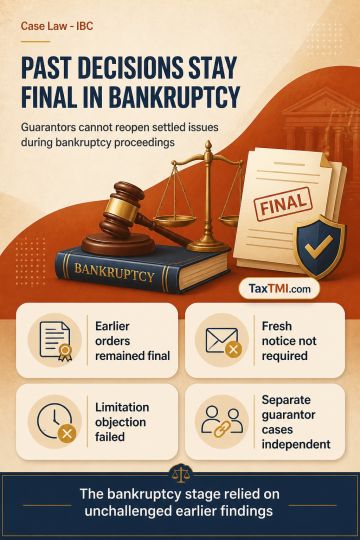
Finality of unchallenged personal insolvency resolution orders prevents a personal guarantor from reopening findings at the consequential bankruptcy stage. Where the guarantor was validly proceeded against ex parte in the resolution process, Section 121 does not require fresh prior notice before a bankruptcy order, particularly where the closure application and bankruptcy petition were served. A limitation objection also fails where an earlier SARFAESI demand enforced security interests rather than invoked the guarantee, and the insolvency application was filed within three years of the subsequent Code demand. Separate proceedings against other guarantors remain independent, and new grounds not raised before the Adjudicating Authority cannot ordinarily be introduced in appeal.
Finality of unchallenged personal insolvency resolution orders prevents a personal guarantor from reopening findings at the consequential bankruptcy stage. Where the guarantor was validly proceeded against ex parte in the resolution process, Section 121 does not require fresh prior notice before a bankruptcy order, particularly where the closure application and bankruptcy petition were served. A limitation objection also fails where an earlier SARFAESI demand enforced security interests rather than invoked the guarantee, and the insolvency application was filed within three years of the subsequent Code demand. Separate proceedings against other guarantors remain independent, and new grounds not raised before the Adjudicating Authority cannot ordinarily be introduced in appeal.
Note: It is a system-generated summary and is for quick reference only.
 TaxTMI
 of 4792

















 Join Channel


 TaxTMI

