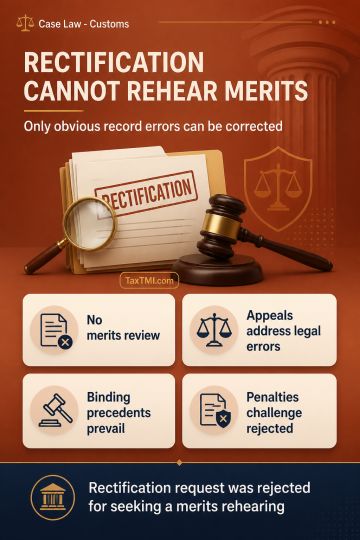
Rectification of mistake remains limited to self-evident record errors, preventing merits review through miscellaneous applications and preserving fin...
Tender creditworthiness conditions may extend to de facto Promoter Directors, with post-participation challenges generally barred absent arbitrariness...
Corporate representation in PMLA summons proceedings permitted through an authorised signatory, subject to directors' continuing cooperation and atten...
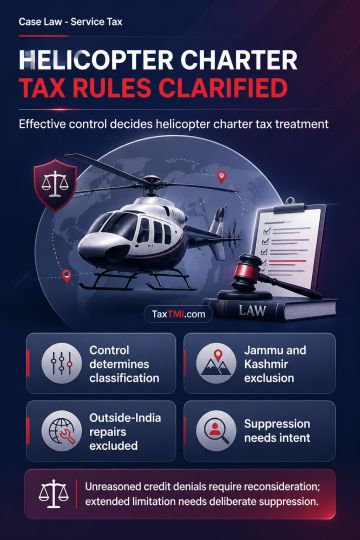
Helicopter charter classification requires effective control analysis, while territorial performance, reasoned credit orders and wilful suppression de...
Specified fund definition expands PAN exemption eligibility for registered alternative investment funds and qualifying International Financial Service...
Page of 4798
Press 'Enter' after typing page number.
821 to 840 of 95955 Results
❮
❯
❯❯
0 / 200
Expand Note
Add to Folder
No Folders have been created
+
Are you sure you want to delete "My most important" ?
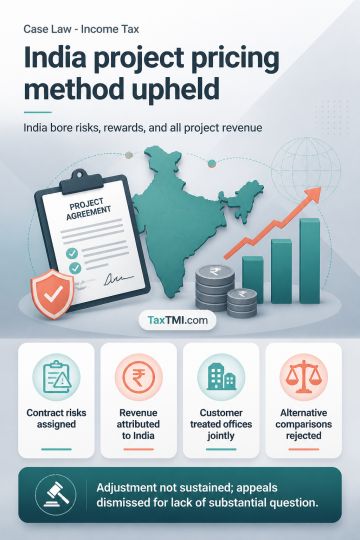
Internal CUP was treated as the most appropriate method for determining the arm's length price of project-office transactions under a turnkey power-project contract. Where the Indian project office bore the contract's risks and rewards, all revenue was attributed to India, and the unrelated customer regarded the head office and project office as one entity, the contract with that customer satisfied the comparability requirements for an internal CUP. CUP was preferred over TNMM as a more direct and suitable method, while the proposed TNMM comparables were rejected. The transfer-pricing adjustment was consequently not sustained, and the appeals were dismissed for lack of a substantial question of law.
Internal CUP was treated as the most appropriate method for determining the arm's length price of project-office transactions under a turnkey power-project contract. Where the Indian project office bore the contract's risks and rewards, all revenue was attributed to India, and the unrelated customer regarded the head office and project office as one entity, the contract with that customer satisfied the comparability requirements for an internal CUP. CUP was preferred over TNMM as a more direct and suitable method, while the proposed TNMM comparables were rejected. The transfer-pricing adjustment was consequently not sustained, and the appeals were dismissed for lack of a substantial question of law.
Note: It is a system-generated summary and is for quick reference only.
 TaxTMI
 of 4798














 Join Channel


 TaxTMI