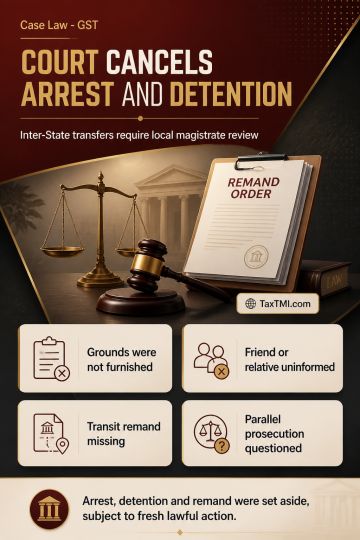
Arrest safeguards and transit remand requirements invalidated detention following inter-State transfer without communicated grounds or magistrate auth...
Arrest safeguards require disclosed grounds, relative intimation and transit remand, while duplicate prosecution under the CGST framework is unsustain...
Document Identification Number defects can invalidate GST assessments, with delayed challenges entertained conditionally where patent irregularities e...
Windmill commissioning evidence supported higher depreciation where grid connection and electricity generation proved operational use before the relev...
Pharmaceutical promotion and transfer-pricing comparability principles limited disallowances, while uncorroborated search allegations and unsupported ...
Business expenditure substantiation supports scrap credits, statutory payments and expense claims, while depreciation requires proof of actual busines...
Floating-rig services are classifiable as Supply of Tangible Goods Service, taxable only from 16 May 2008, rather than Mining Service. Service tax collected under the erroneous classification and borne by the service recipient lacked legal authority under Article 265, supporting refund even though the service provider had not challenged its assessment. Statutory refund limitation did not justify retention where payment arose from a mistake of law caused by misclassification. Certificates establishing that the recipient bore the tax burden supported the finding that refund would not result in unjust enrichment. Appellate authorities and the Tribunal could correct the classification error and grant refund without requiring a civil suit or writ petition.
Floating-rig services are classifiable as Supply of Tangible Goods Service, taxable only from 16 May 2008, rather than Mining Service. Service tax collected under the erroneous classification and borne by the service recipient lacked legal authority under Article 265, supporting refund even though the service provider had not challenged its assessment. Statutory refund limitation did not justify retention where payment arose from a mistake of law caused by misclassification. Certificates establishing that the recipient bore the tax burden supported the finding that refund would not result in unjust enrichment. Appellate authorities and the Tribunal could correct the classification error and grant refund without requiring a civil suit or writ petition.
Note: It is a system-generated summary and is for quick reference only.
 TaxTMI
 of 4792



















 Join Channel



 TaxTMI