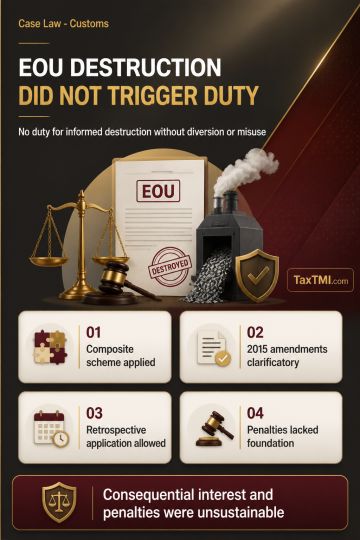
Defined public benefit can retain charitable character; registration renewal requires examining genuine activities and legal compliance, not surplus a...
Capital reduction is distinct from share buy-back, preventing buy-back tax; restructuring interest and related business deductions also survive scruti...
Transfer pricing and tax deductions upheld on established principles, while employee contributions and warranty provisions returned for fresh examinat...
Captive transfer pricing relies on industrial consumer tariffs, while genuine quotations can benchmark effluent treatment transfers under the Other Me...
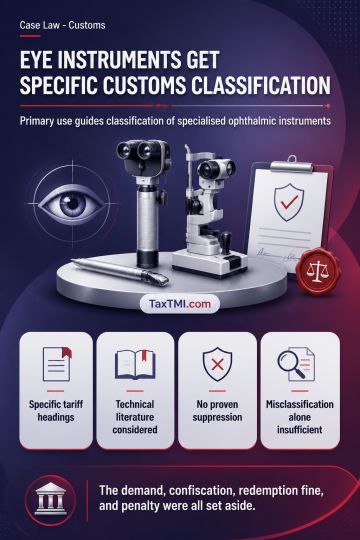
Specific tariff classification for ophthalmic instruments and extended limitation principles determine the treatment of duty demands, confiscation, an...
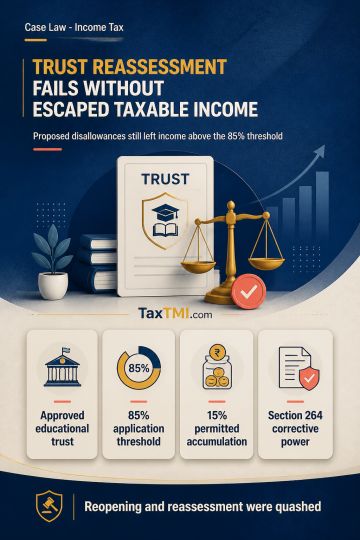
Reassessment of an approved educational trust is unwarranted where, even after proposed disallowances, income applied to its objects remains above the 85% exemption threshold and no taxable income escapes assessment. The proviso to section 10(23C)(vi) permits accumulation of up to 15% of income, while section 152(2) permits reassessment proceedings to be dropped if the alleged escaped income does not reduce the assessed tax liability. Reopening and consequential reassessment were quashed. Revisionary power under section 264 may also modify, revoke or set aside an assessment made contrary to an interim court order, provided the resulting order is not prejudicial to the assessee; administrative system limitations do not excuse failure to remedy the breach.
Reassessment of an approved educational trust is unwarranted where, even after proposed disallowances, income applied to its objects remains above the 85% exemption threshold and no taxable income escapes assessment. The proviso to section 10(23C)(vi) permits accumulation of up to 15% of income, while section 152(2) permits reassessment proceedings to be dropped if the alleged escaped income does not reduce the assessed tax liability. Reopening and consequential reassessment were quashed. Revisionary power under section 264 may also modify, revoke or set aside an assessment made contrary to an interim court order, provided the resulting order is not prejudicial to the assessee; administrative system limitations do not excuse failure to remedy the breach.
Note: It is a system-generated summary and is for quick reference only.
 TaxTMI
 of 4805













 Join Channel


 TaxTMI